
Entrepreneurial Operating System: The Smart Way to Build a Stronger, Better-Run Business
The entrepreneurial operating system is one of the most practical and powerful business frameworks available to companies that want to stop feeling chaotic and start operating with clarity, discipline, and momentum. In simple terms, EOS is a complete set of tools and principles designed to help business leaders get everyone aligned, solve issues faster, strengthen accountability, and create a healthier organization that performs consistently. For many growing businesses, the biggest challenge is not a lack of ambition or talent. It is the absence of a simple operating system that keeps everyone moving in the same direction. That is exactly where EOS becomes valuable.
Businesses often reach a point where growth begins to create confusion. Leaders work harder but seem to get less control. Teams become busy, but not always productive. Meetings happen, but decisions still get delayed. Roles overlap, responsibilities blur, and important priorities get lost in the daily noise. The entrepreneurial operating system helps fix these problems by giving organizations a clear structure for how to run the business instead of letting the business run them. It does not rely on complicated theory or corporate jargon. Instead, it focuses on practical execution, measurable goals, and disciplined follow-through. That is why so many companies, especially small and mid-sized businesses, are drawn to EOS when they want to improve performance without creating more complexity.
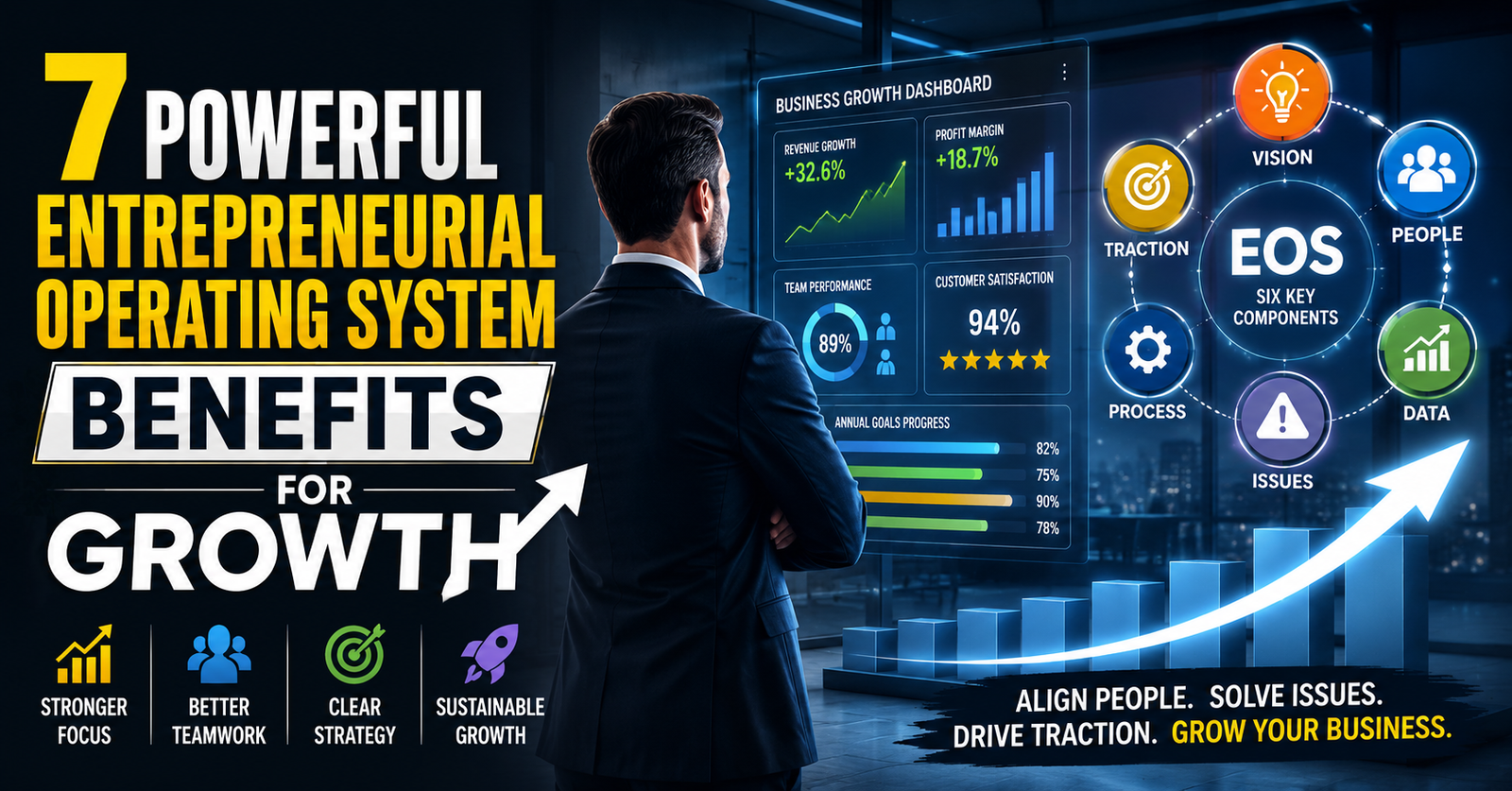
At its core, EOS is built around the idea that every business needs six key components working together: Vision, People, Data, Issues, Process, and Traction. When these six elements are strong and aligned, the business becomes easier to manage and more likely to grow in a healthy way. When one or more of them are weak, the company can feel stuck, even if sales are growing. The entrepreneurial operating system gives leadership teams a way to diagnose what is happening inside the business and take practical steps to improve it. Instead of guessing why problems keep repeating, leaders can use EOS tools to identify root causes, make clearer decisions, and create lasting improvement.
One of the biggest strengths of the entrepreneurial operating system is its simplicity. Many management frameworks are filled with complicated concepts that look good on paper but are difficult to use in real life. EOS is different because it is intentionally straightforward. It helps leaders define where the business is going, who is responsible for what, how success will be measured, and what issues must be solved right now. This simplicity makes it easier for teams to adopt the system and actually use it every day. A framework only works when people apply it consistently, and EOS is built with that in mind.
For business owners, the biggest frustration is often the gap between vision and execution. A company may have exciting plans, but if those plans never become clear priorities, measurable goals, and weekly action, progress stays slow. The entrepreneurial operating system bridges that gap by turning strategy into action. It helps leadership teams create a one-year picture, set quarterly priorities, and track progress in a way that keeps everyone focused. This kind of structure matters because businesses do not fail only from bad ideas. Many fail because good ideas are never executed well. EOS gives leaders a way to make execution a habit rather than a hope.
The entrepreneurial operating system also improves accountability, which is one of the most important ingredients in a high-performing business. Many organizations struggle because no one is fully sure who owns what. Tasks get shared, but not truly owned. Meetings end with vague next steps. Deadlines drift. The result is frustration, duplication, and missed opportunities. EOS addresses this by clarifying roles and creating ownership at every level. When people know exactly what they are accountable for, performance becomes easier to measure and manage. This does not mean leaders become controlling. It means they create a culture where responsibility is clear and progress is visible.
Another reason EOS is effective is that it helps leaders focus on the right data. Many businesses rely on gut instinct alone, which can be useful but is never enough. The entrepreneurial operating system encourages companies to track a handful of critical numbers that reveal the health of the business. These numbers act like a dashboard. They do not tell every detail, but they show whether the company is on track or drifting off course. When leaders review the right data every week, they can make faster decisions and avoid surprises. This habit alone can dramatically improve business performance over time.
EOS is also powerful because it creates a healthier meeting culture. In many businesses, meetings are long, unstructured, and unproductive. People leave feeling like time was wasted. The entrepreneurial operating system introduces a more disciplined approach so meetings have a purpose, follow a clear agenda, and produce real decisions. Weekly leadership meetings become a tool for solving issues, reviewing numbers, and aligning on priorities rather than a forum for repeating the same complaints. This matters because the quality of meetings often reflects the quality of the business itself. Better meetings usually lead to better execution, better communication, and better results.
The Vision component of EOS is especially important because every business needs a shared destination. If the leadership team is not aligned on where the business is going, the rest of the organization will feel the confusion. EOS helps leaders define their vision in a way that is simple, clear, and repeatable. This vision should answer key questions such as what the company stands for, what its target market is, what differentiates it, and what success looks like in the future. When everyone understands the vision, decision-making improves because people can judge choices based on whether they support the direction of the company.
The People component is equally critical because a business cannot grow beyond the strength of its team. The entrepreneurial operating system stresses the importance of having the right people in the right seats. This means not only hiring talented individuals, but also making sure their values and behaviors fit the company’s culture and that they are placed in roles where they can succeed. Many business problems are not process problems at all. They are people problems. EOS gives leaders a healthier way to address these issues by focusing on fit, accountability, and team structure rather than relying on assumptions or hope.
Data is another area where many companies struggle. Leaders often drown in too much information while still missing the numbers that really matter. EOS solves this by helping businesses choose a small set of key metrics that truly reflect performance. These numbers could relate to sales, customer satisfaction, production, retention, cash flow, or any other critical area depending on the business. The important point is that the team becomes accountable to real data rather than opinions. This encourages objectivity and makes it easier to spot trends early. Over time, this practice can prevent small issues from becoming expensive problems.
The Issues component of the entrepreneurial operating system is one of its most practical tools because every business has issues. The difference between high-performing companies and struggling ones is not that one has problems and the other does not. It is that strong companies identify and solve problems more effectively. EOS teaches teams to become better issue-solvers by bringing problems into the open, discussing them honestly, and resolving them at the root. This can transform a culture that once avoided difficult conversations into one that addresses challenges directly and constructively. That shift alone can make a business much stronger.
The Process component helps businesses stop relying on tribal knowledge and chaos. Many companies function because a few experienced employees know how everything works in their heads. That can work for a while, but it creates risk and inconsistency. EOS encourages businesses to document their core processes so work becomes repeatable, scalable, and easier to train. This does not mean creating endless manuals that nobody reads. It means defining the essential way the business gets important work done. When processes are clear, quality improves, onboarding becomes easier, and the company is less dependent on a few key individuals.
Traction is the final component, and it is where the entrepreneurial operating system becomes especially powerful. Traction is about discipline, execution, and accountability. A business can have a great vision and talented people, but without discipline, little changes. EOS introduces a rhythm of goal-setting, weekly focus, and measurable follow-through that keeps the company moving. One of the most useful habits within this component is the practice of quarterly priorities. Rather than trying to do everything at once, the team focuses on the few most important objectives for the next 90 days. This keeps energy directed toward what matters most and makes progress much easier to achieve.
The 90-day focus is one of the reasons many leaders find EOS refreshing. It breaks the year into manageable chunks and reduces the overwhelm that often comes with long strategic plans. Instead of creating a list of goals that nobody remembers, the team works on a few critical priorities, reviews them regularly, and adjusts as needed. This approach keeps momentum alive and makes the business more agile. It also creates a natural cycle of reflection and improvement, which is essential for long-term success. Growth becomes more intentional and less random.
Another major benefit of the entrepreneurial operating system is that it strengthens leadership teams. In many businesses, leaders are busy but disconnected. They may manage different functions, but they are not always operating as a true team. EOS helps leadership groups become more unified by giving them a shared language, a common set of priorities, and a consistent way to solve problems. When leadership is aligned, the rest of the company feels the difference. Communication becomes clearer. Decisions become faster. Trust improves. The organization starts to feel more stable and more capable.
The entrepreneurial operating system is especially useful for companies experiencing rapid growth. Growth can be exciting, but it also brings stress, bottlenecks, and complexity. What worked at a smaller stage may no longer work when the business grows. EOS helps leaders build structure before chaos gets out of control. It creates the kind of foundation that supports expansion without sacrificing culture or execution. Businesses that adopt EOS often find that they can scale more confidently because they are not constantly reinventing the wheel. They have a system that supports growth.
It is also worth noting that EOS is not only for struggling businesses. Strong businesses use it too, because even successful companies need clarity and discipline to keep growing. In fact, some of the best candidates for EOS are businesses that are doing well but know they could be better. They may already have sales, customers, and traction, but they want more consistency, better teamwork, and stronger accountability. EOS helps them move from good to great by refining how the business operates. It turns success into something more repeatable rather than leaving it up to heroic effort.
A key reason the entrepreneurial operating system works is that it makes abstract business concepts concrete. Vision becomes a written picture that everyone can understand. Accountability becomes role clarity. Strategy becomes a set of measurable priorities. Problems become issues to solve. Process becomes a documented way of working. Traction becomes weekly discipline. This translation from theory to action is what makes EOS so practical. Business owners do not just need more information. They need a way to apply that information. EOS provides that bridge.
The system also encourages healthier communication. In many organizations, people avoid direct conversations because they fear conflict or do not know how to raise issues constructively. EOS gives teams a framework for open, honest discussion without letting meetings turn into chaos. When leaders and employees know there is a proper place and process for raising concerns, communication becomes more productive. People stop gossiping behind the scenes and start solving problems in the room. That cultural shift is valuable because strong communication reduces misunderstandings and builds trust.
The entrepreneurial operating system can also have a positive effect on company culture. Culture is often described in vague terms, but in practice it comes down to what people consistently value, reward, and tolerate. EOS helps culture become more intentional by aligning the team around shared values, clear expectations, and visible accountability. When leaders consistently reinforce the right behaviors and address the wrong ones, culture improves. Employees tend to feel more secure and more engaged when they know what the company stands for and how success is measured.
One of the most overlooked benefits of EOS is how much mental relief it gives leaders. Business ownership can feel isolating and overwhelming, especially when the owner is pulled in every direction. The entrepreneurial operating system reduces that burden by creating structure. Leaders no longer have to carry everything in their heads. They can rely on a shared system to organize priorities, solve problems, and track progress. That can free up mental bandwidth for more strategic thinking and better decision-making. In a business environment filled with uncertainty, that clarity is incredibly valuable.
EOS can also improve employee engagement when it is implemented well. People generally want to do good work, but they become disengaged when expectations are unclear or when leadership seems inconsistent. When a company uses the entrepreneurial operating system properly, employees get more visibility into what matters, how they contribute, and what success looks like. That creates a stronger sense of purpose. People are more likely to engage when they understand the mission and see that their work matters. Clear systems and accountability do not crush motivation; they often strengthen it.
Of course, like any business framework, EOS only works if leaders commit to using it consistently. It is not a magic fix and it does not solve every problem overnight. The real value comes from discipline. Leadership teams must be willing to have honest conversations, define roles clearly, review data regularly, and hold each other accountable. Businesses that treat EOS as a one-time workshop will not get the full benefit. But companies that embrace it as an operating rhythm often see lasting improvements in communication, execution, and overall business health.
Implementation usually begins with leadership alignment. The top team must first agree on the vision, priorities, and responsibilities of the business. Once that happens, the system can be introduced throughout the organization in a structured way. The goal is not to overwhelm everyone with change at once. The goal is to create steady improvement through consistent use of the tools. Over time, the business develops a rhythm that supports better execution. This gradual, practical approach is one reason EOS is more sustainable than many complicated transformation programs.
For business owners thinking about long-term growth, the entrepreneurial operating system offers something extremely valuable: predictability. Not predictability in the sense that every challenge disappears, but predictability in the sense that the business becomes more manageable. Leaders know how to review progress, how to identify issues, how to assign accountability, and how to keep the team focused. That kind of structure reduces uncertainty and gives the company a stronger foundation for future expansion. It is much easier to scale a business that is well run than one that depends on constant heroics.
Another important advantage is that EOS helps protect the founder from becoming the bottleneck. In many businesses, the founder makes too many decisions, approves too many details, and becomes involved in too many day-to-day issues. This can limit growth and create burnout. The entrepreneurial operating system encourages delegation, accountability, and role clarity so the business can function more independently. That does not mean the founder becomes less important. It means the business becomes less dependent on one person for every answer. That shift is essential for growth.
Many companies also appreciate that EOS is adaptable across industries. Whether a business is in professional services, manufacturing, healthcare, technology, real estate, marketing, or retail, the core ideas still apply. Every organization needs vision, people, data, issues, process, and traction. The specific metrics and processes may change, but the structure remains useful. This flexibility makes EOS appealing to a wide range of businesses. It is not built for one niche alone. It is a universal framework for running a company more effectively.
Businesses that adopt the entrepreneurial operating system often report better meeting discipline, stronger teamwork, and more clarity around goals. These outcomes may sound simple, but they have a powerful effect on the bottom line. When teams spend less time confused, reactive, or misaligned, they spend more time making progress. That improvement compounds. Small gains in accountability and execution can create large gains in revenue, customer experience, and operational efficiency over time. In that sense, EOS is not just a management system. It is a growth multiplier.
The reason this framework continues to attract attention is that it speaks to a real pain point in business: too much complexity, not enough clarity. Leaders do not need more noise. They need a system that helps them focus, decide, and act. The entrepreneurial operating system delivers exactly that. It gives structure without suffocating creativity. It promotes discipline without killing flexibility. It creates accountability without turning the organization into a rigid machine. That balance is part of what makes EOS so effective and so widely respected.
For companies that are tired of uneven results, unproductive meetings, or repeated problems, EOS can be a turning point. It gives the leadership team a common language and a practical operating rhythm. It turns vague goals into concrete actions. It reduces chaos and increases traction. Most importantly, it helps the business become healthier from the inside out. That is what makes it so attractive to owners who want not just more growth, but better growth.
If your business feels stuck, scattered, or too dependent on a few people, the entrepreneurial operating system may be exactly the kind of framework you need. It can help you sharpen your vision, improve your team, simplify your processes, and build stronger momentum. It is not about working harder forever. It is about building a business that runs better, grows smarter, and creates less stress for the people inside it. And in a competitive market, that kind of advantage matters more than ever.
The best time to improve how your business runs is before chaos becomes normal. EOS gives you a path to do that with clarity and confidence. When leaders commit to a better system, everything changes: meetings become more useful, goals become more visible, teams become more aligned, and decisions become easier to make. That is why the entrepreneurial operating system is not just another business trend. It is a practical way to create lasting traction, stronger leadership, and a more scalable company.
If you are serious about building a business that performs better and feels easier to run, now is the right time to explore EOS more deeply and take the first step toward a more organized, focused, and accountable future. The entrepreneurial operating system can help you turn frustration into momentum, confusion into clarity, and scattered effort into real progress. That is the kind of transformation every business deserves.