
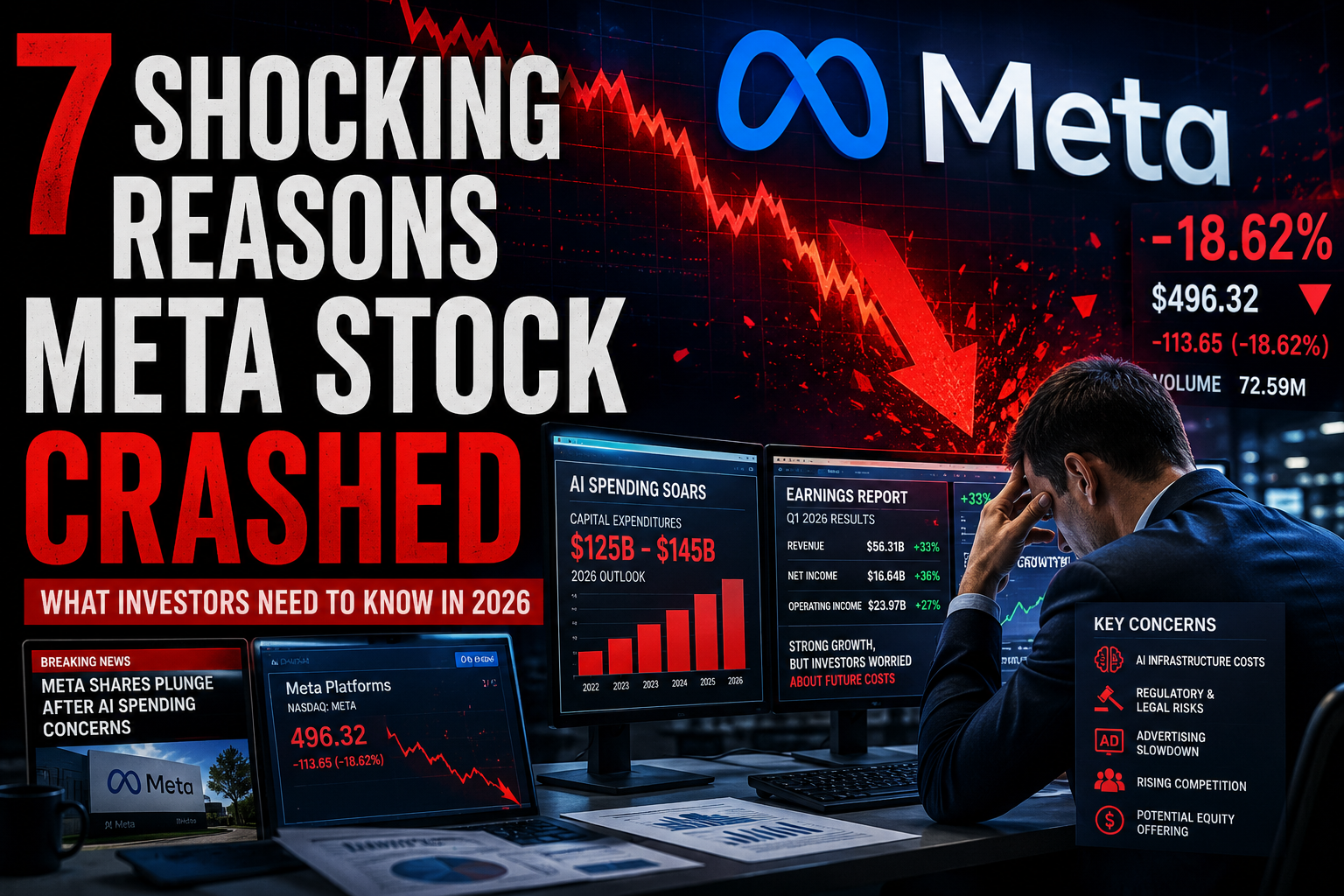
Meta stock has dropped sharply at different moments for different reasons, but the pattern is surprisingly consistent: investors react fast when growth expectations, profit margins, or long-term spending plans start to look less predictable. That is why the question “why did Meta stock drop” keeps coming up. The short version is not that Meta suddenly became a weak company. In fact, recent earnings have often shown strong revenue growth.
The real issue is that Wall Street tends to punish Meta whenever the company’s spending rises faster than investors think it should, especially when that spending is tied to AI infrastructure, legal risk, or another expensive long-term bet. In other words, Meta usually falls not because the business is collapsing, but because the market begins to fear that future profits may be delayed, diluted, or redirected.
At a deeper level, Meta is one of those companies that trades on trust as much as on numbers. When revenue rises but guidance feels cautious, the stock can still fall hard. When earnings are solid but expenses are climbing even faster, the market may decide the company is spending too aggressively. And when that spending is connected to AI, the metaverse, or new infrastructure projects, investors often ask the same question: when will those billions actually turn into durable returns?
That is the real tension behind Meta’s sell-offs. The company can be growing, profitable, and innovative at the same time, yet still see its stock price hit if investors believe the path from spending to profit is becoming too expensive or too uncertain.
The biggest reason Meta stock drops is that the market hates uncertainty
The first thing to understand is that stock prices are not only about what a company earned last quarter. They are about what investors think the company will earn next year, and the year after that. Meta is especially sensitive to this because its business model depends heavily on advertising, user engagement, and massive infrastructure investments. If any one of those pillars looks unstable, the stock can reprice quickly. That is why even good earnings do not always protect Meta from a decline. The market may decide that the future has become harder to forecast, and once that happens, the stock can fall even when the headline results look strong.
This is one reason the phrase “why did Meta stock drop so much” does not have only one answer. Sometimes the decline is triggered by a weaker forecast. Sometimes it is triggered by expenses. Sometimes it is triggered by a regulatory headline. And sometimes it is simply a fear that the company is spending too much to defend its leadership position.
Meta has spent years trying to balance today’s ad machine with tomorrow’s platform bets, and that balancing act creates volatility. Investors may love the scale of the business, but they also demand proof that the scale is still translating into margins and cash flow. When that proof feels less certain, the stock often falls first and gets re-evaluated later.
AI spending is the newest pressure point on Meta stock
The most recent reason for Meta’s stock weakness is the company’s aggressive AI spending. Meta reported a strong first quarter in 2026, with revenue up 33% year over year to $56.3 billion and operating income still very large. But the same release showed that costs and expenses also rose sharply, and investors paid close attention to the direction of spending rather than just the direction of sales. That is the key issue: Meta is growing, but it is also spending heavily to support AI development, compute infrastructure, and data centers. When capital expenditures rise at this pace, shareholders start asking whether the return on that spending will arrive soon enough to justify the cash burn.
Reuters reported in April 2026 that Meta raised its annual capital spending forecast to between $125 billion and $145 billion, and that the market reacted badly to the higher expected spend. That kind of number is huge even for a company as large as Meta, because it signals a long stretch of investment before the payoff is fully visible. The problem is not just the amount itself. It is the fact that investors must trust management to convert that spending into future productivity, stronger ad tools, better AI products, and long-term strategic advantage. When the scale of the spending gets this large, every additional billion dollars can start to look like a test of discipline.
That same anxiety deepened in June 2026 when Reuters reported that Meta was considering a large equity offering to help finance AI infrastructure, with the report adding that the stock fell 6.6% on the news. For a company that many investors associate with enormous cash generation, the idea of raising equity can feel like a warning sign, even if the company is still highly profitable. Equity financing can be interpreted as a signal that management believes the investment wave is so big that internal cash flow alone may not be enough. Whether that interpretation is fully fair or not, markets often react to perception before they react to accounting.
Meta’s ad business is still strong, but the market remembers every slowdown
Another reason Meta stock has fallen so dramatically in the past is that the advertising business can look extremely resilient right up until the moment investors start doubting it. In 2022, Meta shares plunged after the company warned about weaker revenue and rising costs. Reuters reported that the company blamed Apple’s privacy changes and growing competition from rivals such as TikTok, and that daily active users declined for the first time at the time. That mattered because Meta’s entire business depends on keeping users engaged enough to sell advertisers valuable attention. If the user growth story weakens, or if ad targeting becomes less effective, the market begins to assume that future revenue growth may slow.
That history still shapes how investors interpret Meta today. Even when the company posts strong quarterly numbers, the memory of earlier slowdowns remains fresh. The market knows that digital advertising is cyclical, competitive, and vulnerable to platform changes outside Meta’s direct control. Privacy updates, shifts in user behavior, and the rise of short-form video have all shown that Meta’s ad machine is powerful but not invincible. So when the company signals that it needs to spend more to protect or expand that machine, investors do not always see it as simple growth. They often see it as defensive spending that may be necessary, but not necessarily cheap.
The 2024 drop was a warning shot about spending versus payoff
If you want to understand why Meta stock dropped so much in the past, 2024 is one of the clearest examples. Reuters reported that Meta disappointed investors with higher expenses and lighter-than-expected revenue, and the stock fell about 15% in extended trading, wiping out close to $200 billion in market value. The market’s reaction showed that even a company with strong scale can be punished heavily when costs rise faster than expected. What investors feared was not simply that Meta was spending money. They feared that the spending could outpace the benefits, especially as the company tried to fund AI development and keep its growth story alive at the same time.
That 2024 episode still matters because it changed the market’s standards. After a move like that, investors become less tolerant of any new surprise related to spending or margin pressure. If Meta later raises capex guidance again, or if management hints that AI infrastructure will require even more investment than previously expected, the market remembers 2024 and assumes the same mistake could happen again. In practical terms, that means Meta has to prove itself more than many other large-cap tech companies. It is not enough to say, “We are investing for the future.” The company has to show that each phase of investment is producing measurable business value.
Legal risk is now part of the Meta stock story
Another reason investors have become cautious is legal and regulatory exposure. In March 2026, Reuters reported that Meta shares fell 7% after two U.S. jury verdicts raised fears of wider litigation risk, including possible future liabilities tied to how the company designs its platforms. Even if the immediate fines were relatively modest, the market looked beyond the immediate dollar amounts and focused on the possibility of much larger future costs. That is often how stock prices react to legal news: investors do not only price the verdict itself, but the precedent it might set.
This matters because Meta is not just a consumer app company anymore. It is also a major infrastructure, AI, and advertising platform with enormous regulatory visibility. Any legal development that suggests the company may face more lawsuits, more oversight, or more expensive compliance obligations can weigh on the stock. The reason is simple. Legal risk can reduce margins, distract management, and force changes to product design or business practices. Even if those changes are manageable, the market usually discounts them before the full financial impact is known.
Why investors react so sharply even when Meta reports strong earnings
Meta often finds itself in a strange position: the business performs well, but the stock still falls. That is because public markets are forward-looking and sometimes unforgiving. Meta’s first quarter of 2026 is a perfect example. The company posted strong revenue growth and excellent net income, but the market did not focus only on what Meta had already earned. It focused on what the company might need to spend next to stay ahead in AI. In other words, a strong quarter does not always protect a stock when the next quarter looks more expensive than expected.
This is also why Meta is often judged differently than slower-growth companies. For a mature business, the market may reward profitability and steady dividends. But for Meta, the valuation reflects a belief that it should keep expanding, innovating, and dominating new product categories. That means the stock can be hit from either side: if growth slows, investors worry about the core business; if spending rises, investors worry about the future return on capital. Meta is constantly asked to prove both growth and discipline at the same time, and that is a very difficult standard to meet quarter after quarter.
The metaverse, AI, and the “future bet” problem
Meta’s stock has also been pressured at different times by the market’s discomfort with large future bets. In earlier years, that meant the metaverse. More recently, it has meant AI infrastructure. The common thread is the same: Meta asks investors to believe that today’s spending will create tomorrow’s strategic moat. Sometimes the market accepts that argument. Sometimes it does not. When sentiment turns skeptical, the stock can fall fast because investors start discounting future earnings more aggressively. That is why Meta can feel like both a growth company and a value trap depending on the news cycle.
The challenge is that future bets are not inherently bad. In fact, they are often how tech giants stay relevant. But future bets become a problem when the timeline to payoff gets longer, the cost gets higher, or the outcome becomes harder to measure. That is exactly where Meta has been under pressure. The company is not being punished for lack of ambition. It is being punished because investors want a clearer bridge between ambition and profit. Until that bridge feels more visible, the stock is likely to remain sensitive to any sign of overspending.
The market is also comparing Meta with other AI spenders
Meta does not operate in isolation. Investors are comparing it with other tech giants that are also spending aggressively on AI infrastructure. Reuters noted in June 2026 that Meta’s possible financing plans came amid a broader wave of AI-related spending across the industry, with capital raising and debt financing becoming more common. That comparison matters because it changes the lens through which investors evaluate Meta. The question is no longer only whether Meta is spending a lot. It is whether Meta’s spending is efficient relative to peers and whether the company is using its scale as an advantage or letting costs outrun returns.
When markets compare companies in the same sector, sentiment can move very quickly. If one peer appears to raise money more efficiently, or if another company gets stronger investor enthusiasm for the same type of AI investment, Meta may be judged more harshly. That competitive pressure creates a kind of valuation race: every company wants to be seen as the smartest spender, not merely the biggest spender. For Meta, that means it is not enough to say AI is important. Management has to convince the market that Meta’s version of AI spending will deliver a better return than the money being deployed by rivals.
What Meta is doing right, and why the stock can still fall anyway
It is important to keep the picture balanced. Meta is still a highly profitable company with major revenue growth, a massive user base, and a strong advertising ecosystem. Its Q1 2026 results showed that the core business was not broken. That is why the stock’s drops should not automatically be interpreted as signs of collapse. More often, they are signals that the market wants more proof, better timing, or lower spending. Meta is still generating significant cash and still has major strategic advantages. The issue is not whether the company is relevant. The issue is how much investors believe that relevance should cost.
The company is also trying to communicate a long-term vision that extends beyond one quarter’s results. Meta’s investor relations page continues to highlight its earnings, financial releases, and strategic updates, which is a reminder that the company wants the market to view it as a platform builder rather than just an ad company. That framing can support the stock when the story is working. But when spending climbs and uncertainty rises, the same long-term framing can make investors more cautious, because the time horizon becomes harder to price. In the stock market, story and numbers need to reinforce each other. When they drift apart, volatility usually increases.
So, why did Meta stock drop so much?
The clearest answer is that Meta stock drops when investors fear that today’s costs are rising faster than tomorrow’s profits. Sometimes the trigger is weak revenue guidance. Sometimes it is AI spending. Sometimes it is legal risk. Sometimes it is a slowdown in ad growth or a broader change in market sentiment. In 2022, the shock came from privacy changes, competition, and weaker user trends.
In 2024, it came from higher expenses and lighter revenue. In 2026, the pressure has centered on heavy AI capital spending, the possibility of new financing, and fresh legal concerns. Put together, these episodes tell one consistent story: Meta is a world-class company, but its stock is extremely sensitive to any sign that the future will cost more than investors expected.
For readers, the most useful takeaway is not that Meta is doomed, but that Meta is a “show me” stock. The market rewards it when growth is strong and spending looks disciplined. The market punishes it when spending looks open-ended or when management asks investors to be patient for too long. That is why the stock can fall hard even when the business itself remains powerful. The company is trying to build the next generation of social, advertising, and AI products, and that ambition is expensive. As a result, the stock keeps swinging between excitement and skepticism, often in very large moves.
Final thoughts and a strong CTA for readers
If your goal is to understand why Meta stock dropped so much, the answer is really about the gap between performance and expectations. Meta may post strong revenue growth, but if investors see too much spending, too much legal risk, or too much uncertainty around the payoff from AI, the stock can still fall sharply. That is exactly what has happened in several recent sell-offs. The lesson for anyone following Meta is to look beyond the headline revenue number and pay close attention to capex guidance, margin trends, legal headlines, and management’s confidence about future returns. Those are the signals that usually move the stock before the next big surprise hits.
Stay updated on Meta’s earnings, spending plans, and regulatory news, because those are the real drivers behind the next major move. If you are researching the company for investing, publishing, or SEO content, keep watching how the market reacts to AI spending versus actual profit growth. That comparison will tell you far more than a single price drop ever can.