

When choosing a home internet provider, one of the most important questions people ask is, “Is Verizon Internet good?” Verizon is one of the biggest names in telecommunications in the United States, but the quality of its home internet service can depend heavily on which Verizon connection is available at your address. In some locations, customers can get Verizon Fios, a fiber-optic service known for fast and balanced upload and download speeds. In other areas, Verizon offers 5G Home Internet, which uses Verizon’s cellular network to provide broadband without a traditional wired connection.
So, is Verizon Internet good in 2026? For many households, the answer is yes. Verizon can be an excellent choice for streaming, gaming, remote work, video calls, large downloads, smart-home devices, and everyday browsing. However, that does not mean every Verizon customer will have exactly the same experience. Fiber availability, local network conditions, home Wi-Fi equipment, signal strength, neighborhood infrastructure, and the type of plan you choose can all affect performance.
Table of Contents
Verizon currently offers Fios plans ranging from 300 Mbps up to a 2 Gig connection in eligible locations, while its 5G Home Internet plans can provide different performance levels depending on the cellular spectrum and address. Verizon itself notes that 5G Home speeds vary according to location, equipment, network connection, and other factors affecting cellular networks.
This detailed Verizon Internet review explains the advantages and disadvantages, speeds, reliability, pricing considerations, gaming performance, streaming experience, customer satisfaction, equipment, 5G versus Fios, and the type of household that is most likely to benefit from Verizon.
Is Verizon Internet Good for Most Households?
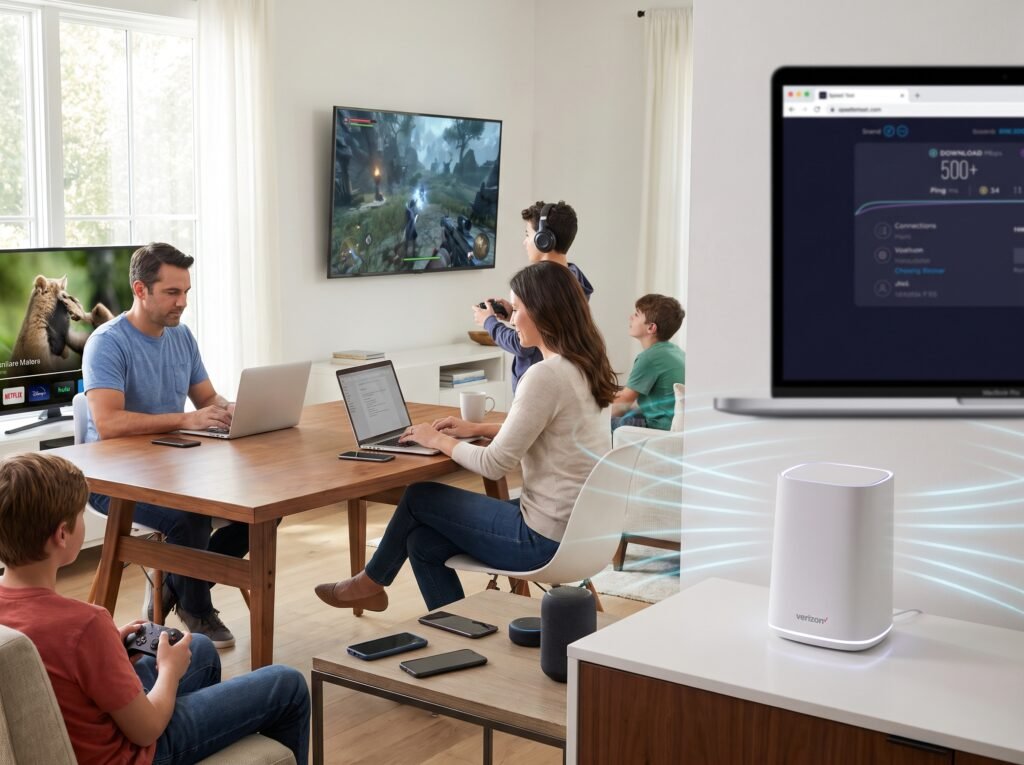
Yes, Verizon Internet is good for many households, particularly when Fios fiber is available. Fios provides a dedicated fiber connection with symmetrical or near-symmetrical upload and download performance, making it especially useful for people who regularly upload large files, participate in video conferences, stream high-resolution content, work from home, or play online games.
Verizon’s current Fios lineup includes 300 Mbps, 500 Mbps, 1 Gig, and 2 Gig tiers depending on availability. Verizon says its 2 Gig service has average wired download and upload speeds between 1.5 Gbps and 2.3 Gbps, although real-world wireless performance can vary because of device capabilities, Wi-Fi conditions, network traffic, and other factors.
Verizon 5G Home Internet is a different proposition. Instead of sending internet data through a dedicated fiber line, it uses Verizon’s wireless network. That can make installation easier and can be a very attractive alternative in areas where traditional broadband choices are limited. However, wireless performance can change based on signal conditions, spectrum, congestion, and the customer’s location.
That distinction is important. Asking whether Verizon Internet is good is not quite enough by itself. The better question is whether the Verizon service available at your address is right for your needs.
Why Verizon Internet Gets So Much Attention
Verizon has a strong reputation in the U.S. telecommunications market, but its home internet services stand out for different reasons.
Fios is particularly attractive because fiber technology can deliver extremely fast upload and download performance with low latency. Verizon says Fios allows customers to handle multiple connected devices, high-resolution streaming, video calling, gaming, and large file transfers simultaneously.
The company’s 5G Home Internet service addresses another problem: getting broadband installed without depending on a traditional cable or fiber line. For eligible households, the service can be self-installed or installed relatively simply compared with some conventional wired services.
Verizon has also introduced price-lock guarantees on its current home internet plans. Its current 5G Home offerings include multi-year price-lock guarantees, while Fios plans also advertise long-term price protection on qualifying plans.
For consumers frustrated by unexpected price increases, included equipment charges, or complicated broadband bills, this can make Verizon more attractive.
Verizon Fios vs. Verizon 5G Home Internet
One of the biggest factors in answering “Is Verizon Internet good?” is understanding the difference between Verizon Fios and Verizon 5G Home Internet.
Fios is a fiber-optic service. Fiber sends data using light through optical fiber, giving it excellent capacity and consistent performance. In practical terms, Fios is usually the Verizon service to prioritize when maximum consistency, upload speed, low latency, and high performance are important.
Verizon 5G Home Internet uses Verizon’s wireless network. Instead of a fiber cable running directly into your home, a gateway receives the cellular signal and distributes internet through your home’s Wi-Fi network.
Neither technology is automatically the right choice for every household.
A small apartment with a few devices may be perfectly satisfied with 5G Home Internet. A household with competitive gamers, remote workers, content creators, several 4K streams, and dozens of connected devices may benefit more from Fios if it is available.
The important lesson is that Verizon is not one single internet experience. The technology available at your address matters.
Is Verizon Fios Good?
Verizon Fios is one of the strongest options within Verizon’s internet portfolio. Since Fios uses fiber-optic infrastructure, it can provide fast and stable performance for demanding households.
Verizon currently advertises Fios service beginning at 300 Mbps and extending up to 2 Gig in eligible areas. Its 1 Gig service can offer up to 940 Mbps advertised speed, while the 2 Gig tier provides average wired speeds between 1.5 Gbps and 2.3 Gbps for both downloads and uploads.
The balanced upload performance is particularly valuable. Traditional cable connections have often emphasized download speeds while providing much lower upload capacity. Fiber can be significantly better for uploading large files, backing up data to cloud services, livestreaming, and professional video conferencing.
Verizon also states that its Fios network supports a large number of connected devices and is designed for activities such as gaming, streaming, video calls, and simultaneous use by multiple household members.
For people who want a high-performance home connection and live in a Fios service area, Verizon Fios is often one of the most compelling reasons to choose Verizon.
Is Verizon 5G Home Internet Good?
Verizon 5G Home Internet can be very good, but performance is more dependent on location than Fios.
Verizon’s current documentation shows that different versions of 5G Home can have substantially different typical speeds. For example, the company’s support information lists typical download ranges of 25–85 Mbps for certain 5G Home configurations using mid-band spectrum and 85–300 Mbps for eligible high-band or mmWave configurations. Higher tiers can reach significantly faster levels, with 5G Home Ultimate configurations listed at typical speeds of 300–1,000 Mbps where qualifying high-band service is available.
This variation explains why one person may describe Verizon 5G Home as extremely fast while another may report only moderate performance.
Signal strength, network capacity, spectrum, gateway placement, local congestion, building materials, and distance from network equipment can affect the experience.
The good news is that Verizon’s current 5G Home plans provide unlimited data and include a router, while its current offers advertise all-in pricing and multi-year price-lock guarantees. Verizon also advertises a 30-day money-back guarantee on its 5G Home offerings.
For renters, apartment residents, people who move frequently, or households without access to fiber, this combination can be highly appealing.
Verizon Internet Speed: Is It Fast Enough?
For most ordinary activities, Verizon offers more than enough speed.
Web browsing, email, social media, online shopping, HD video streaming, music streaming, video calls, and general work rarely require enormous bandwidth from a single device. Even a modest broadband connection can handle these tasks.
The need for faster internet becomes more obvious when multiple people are using the connection at the same time.
Imagine a household where one person is attending a video conference, another is streaming a 4K movie, a teenager is downloading a large game, and several smart-home devices are connected in the background. A high-capacity connection can help prevent bottlenecks.
Fios is especially strong in this situation because of its high capacity and fast upload performance. Verizon’s current Fios information lists 300 Mbps, 500 Mbps, 1 Gig, and 2 Gig options depending on location.
5G Home Internet can also be enough for many families, but the actual experience depends more strongly on local wireless conditions. Verizon specifically cautions that 5G Home speeds vary based on address, equipment, network conditions, and outside factors affecting cellular networks.
Therefore, buying the highest advertised speed is not always necessary. The more important question is how many people, devices, and demanding applications will share the connection.
Is Verizon Internet Good for Gaming?
For gaming, Verizon Fios is generally the more attractive option when available.
Online games do not simply depend on download speed. Latency, consistency, packet loss, Wi-Fi quality, and connection stability can have a greater impact on gameplay.
A 1 Gig connection does not automatically make someone a better gamer than a 300 Mbps customer. Many games do not need anywhere near 1 Gig of bandwidth. What matters is how quickly and consistently data moves between your device and the game server.
Fiber is generally well suited to gaming because it offers a wired connection with strong capacity and low-latency characteristics. Verizon’s Fios information emphasizes gaming and low-lag applications as use cases for its fiber service.
5G Home can also work well for casual gaming, but wireless conditions introduce another variable. Verizon’s broadband information lists typical latency ranges for different 5G Home configurations, with some services listed around 35–60 milliseconds depending on the plan and network conditions.
For casual multiplayer games, that may be perfectly acceptable. Competitive players who rely on highly consistent response times may prefer Fios or another high-quality wired fiber service when available.
Is Verizon Internet Good for Streaming?
Yes. Verizon Internet is well suited to modern streaming.
A household can use Verizon for Netflix, YouTube, Disney+, Hulu, live television services, music streaming, and other online entertainment. The real advantage of a faster connection becomes apparent when multiple streams are running simultaneously.
Verizon’s Fios network offers enough capacity for several high-resolution streams while other devices continue using the connection. Its 5G Home service also supports video streaming, although Verizon specifies different streaming optimization levels by plan and network configuration. For example, its current documentation lists 1080p optimization on several 5G Home tiers and up to 4K optimization on eligible 5G Home Ultimate configurations.
For a household with only one or two regular streaming devices, you may not need a premium gigabit plan. For larger households, upgrading can provide additional headroom and improve the experience when several bandwidth-heavy activities happen at once.
Is Verizon Internet Good for Working From Home?
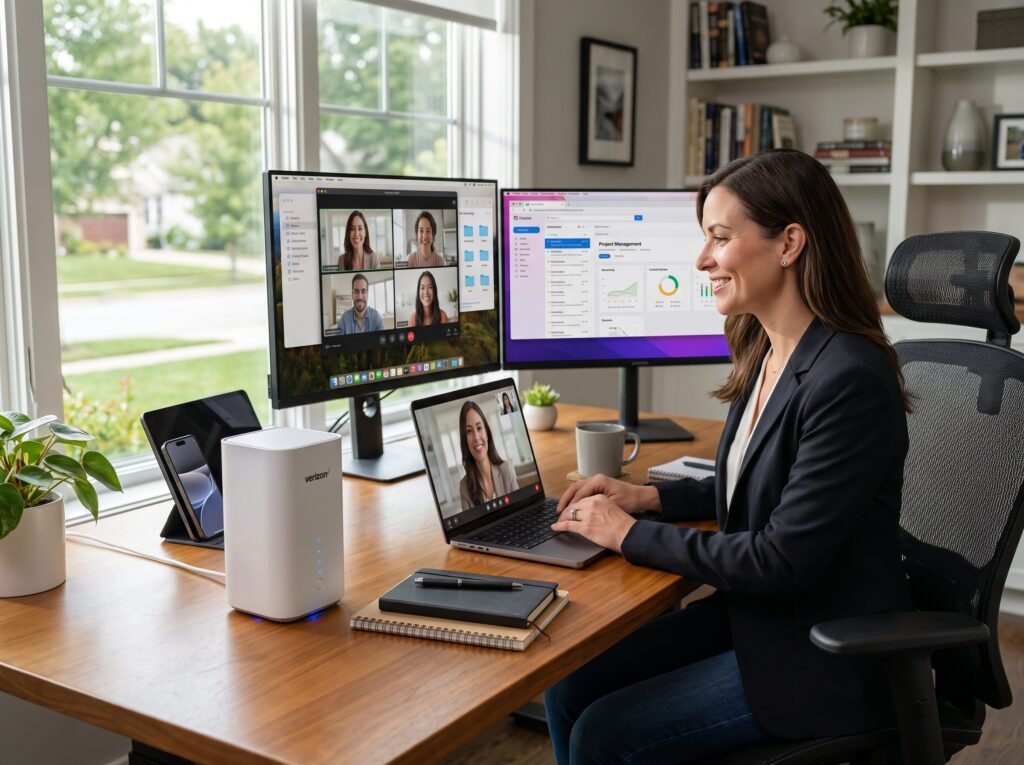
Remote workers should pay close attention to upload speed, reliability, and latency rather than focusing only on the headline download number.
A person working remotely may regularly participate in video meetings, use cloud applications, upload documents, transfer large files, access remote servers, or synchronize cloud storage.
Fios is particularly attractive for these tasks because of its strong upload capability. Verizon states that its 1 Gig Fios service can provide up to 880 Mbps wired upload speed, depending on the plan and location.
For many people, that is far more upload capacity than they will actually use, but the extra headroom can become valuable when several household members are also online.
5G Home Internet can also support remote work, especially where wireless signal quality is strong. However, the greater variability of wireless connections means that a customer who depends on a highly consistent professional connection should test performance carefully.
Is Verizon Internet Reliable?
Reliability depends on the exact service technology and local infrastructure, but Verizon has strong credentials in this area.
J.D. Power’s 2025 U.S. Residential Internet Service Provider Satisfaction Study ranked Verizon highest among wired internet providers in the East region, with a score of 578 compared with a regional wired average of 541. J.D. Power also reported that Verizon achieved this regional ranking for the 13th consecutive year.
That does not mean every Verizon customer will have a perfect connection. Individual experiences can be influenced by local outages, equipment, construction, Wi-Fi interference, router placement, device limitations, or broader network conditions.
For Fios customers, the physical fiber connection can provide a very consistent broadband experience. For 5G Home users, wireless conditions can play a larger role.
One common mistake is blaming the internet provider for every Wi-Fi problem. A strong incoming broadband connection can still feel slow if the router is poorly positioned, the house has thick walls, the wireless network is overcrowded, or the connected device has outdated Wi-Fi hardware.
Verizon Internet Pricing and Value
Pricing is one of the biggest factors consumers consider when choosing an internet provider.
Verizon’s current pricing varies by plan, address, promotions, mobile bundle eligibility, and other conditions. Its 5G Home page currently lists standard prices of $60 per month for 5G Home, $70 per month for 5G Home Plus, and $85 per month for 5G Home Ultimate, while qualifying customers may receive significant discounts through Auto Pay and Verizon mobile bundles.
The company currently advertises a starting price as low as $35 per month when eligible customers combine Auto Pay with a Verizon mobile plan.
Fios pricing also varies, with Verizon currently listing 1 Gig at $99.99 per month and 2 Gig at $119.99 per month before applicable discounts or promotional adjustments on the cited plan pages.
These prices can change, so customers should verify the exact rate and offer for their address before ordering.
The value proposition becomes more attractive when equipment, whole-home Wi-Fi, discounts, price guarantees, and mobile bundling are included. Verizon currently advertises included routers on its home internet plans and Whole-Home Wi-Fi features on qualifying tiers.
Does Verizon Include a Router?
Yes. Verizon’s current 5G Home Internet offerings include a router, and select plans include additional Whole-Home Wi-Fi equipment or an extender. Verizon’s Fios offerings also include routers and Whole-Home Wi-Fi features on qualifying plans.
This can make setup simpler for people who do not want to research and purchase a separate router.
However, advanced users may still have reasons to consider additional networking equipment. Large homes, multi-story houses, home offices, smart-home installations, and households with many wireless devices can benefit from a carefully designed Wi-Fi system.
The broadband connection itself is only one part of the performance equation. Your router, placement, Ethernet wiring, Wi-Fi standard, device capabilities, and building structure all matter.
Verizon’s Whole-Home Wi-Fi Advantage
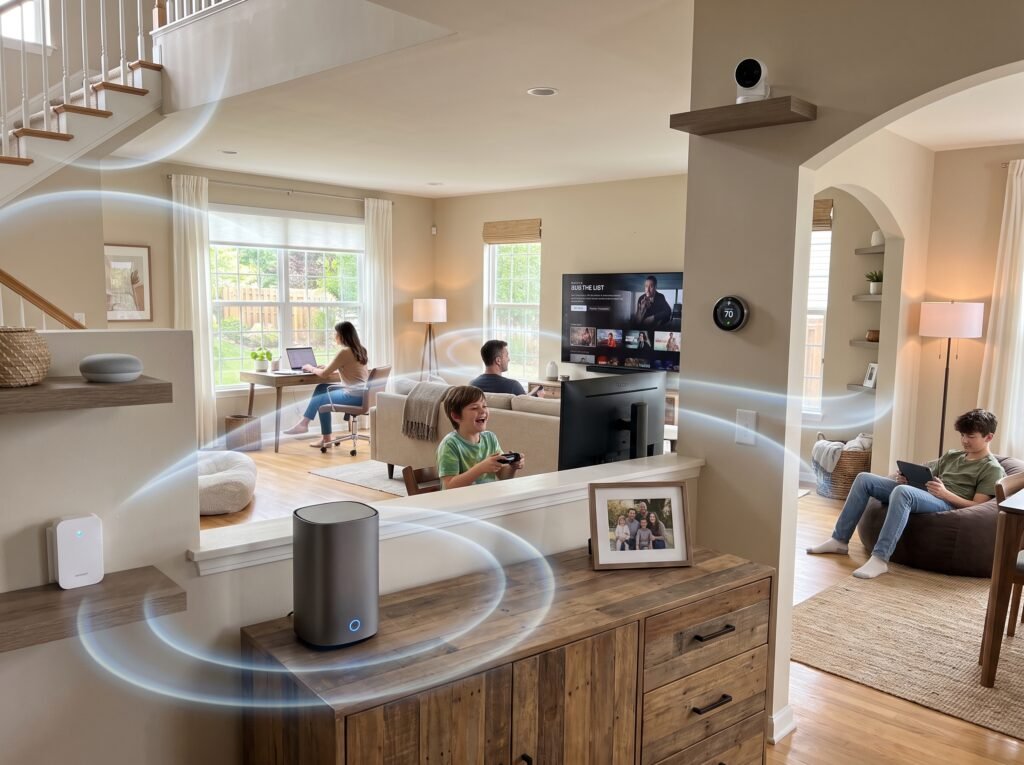
Whole-home coverage has become increasingly important because most homes now have more connected devices than ever.
Smart televisions, phones, tablets, laptops, security cameras, speakers, gaming consoles, smart thermostats, appliances, and streaming devices can all compete for wireless capacity.
Verizon’s current Fios 2 Gig offering includes a Verizon router and one Wi-Fi extender as part of its Whole-Home Wi-Fi package, while qualifying 5G Home Ultimate configurations can also include Whole-Home Wi-Fi equipment.
This can be a meaningful advantage for customers who would otherwise need to purchase mesh equipment separately.
Still, no extender can completely compensate for a weak internet connection coming into the house. Whole-home Wi-Fi is best viewed as an extension of a good broadband connection, not a substitute for one.
Verizon Internet Pros and Cons
Verizon has several meaningful advantages. Its strongest benefit is the quality of Fios where it is available. Fiber provides excellent capacity and fast upload speeds, making it a strong choice for remote work, gaming, content creation, large file transfers, and busy households.
Verizon’s 5G Home Internet is another major advantage because it can provide broadband without the need for traditional cable installation. This makes the service particularly interesting for renters and customers who do not have access to fiber.
Another positive is Verizon’s current approach to equipment and pricing. Eligible plans include routers, while current offers include multi-year price-lock guarantees and discounts for customers who bundle mobile and home service.
There are disadvantages, too. First, Fios is not available everywhere. Verizon’s own coverage information says Fios is available to more than 15 million homes and businesses across its network, with availability concentrated in parts of the Northeast and Mid-Atlantic.
Second, 5G Home performance varies by location. A strong 5G signal can produce an excellent experience, but wireless congestion or weaker signal conditions can reduce performance.
Third, advertised maximum speeds are not the same as the speeds every customer will receive on every device. Verizon explicitly notes that wired and wireless speeds can vary due to device limits, multiple users, network factors, and other conditions.
Is Verizon Internet Good for Families?
For families, Verizon can be an excellent choice, particularly with Fios.
A family may have several people online at the same time. One child might be playing a game while another streams video. Parents may work remotely or attend meetings, while smartphones and smart-home products remain connected.
A faster connection provides greater capacity for simultaneous activities.
The 300 Mbps Fios plan may be sufficient for a smaller household, while 500 Mbps, 1 Gig, or 2 Gig can make more sense for larger homes with many connected devices. Verizon’s own Fios documentation associates its different tiers with increasing device capacity, with its 2 Gig service supporting substantially more devices than its lower tiers under its stated testing and equipment conditions.
Families should not automatically choose the fastest plan, though. A household with five people does not necessarily need 2 Gig internet.
The right plan is the one that gives your household enough capacity without paying for performance you will rarely use.
Is Verizon Internet Good for Small Businesses and Home Offices?
Verizon can be a strong option for a home-based business, especially when Fios is available.
Upload performance becomes particularly important for photographers, designers, video editors, developers, consultants, online sellers, streamers, and other professionals who regularly transfer large files.
Fiber’s balanced upload and download capabilities can significantly reduce the time needed to send large files to cloud storage or clients.
Verizon’s Fios 1 Gig and 2 Gig services are especially appealing for demanding home-office environments because Verizon advertises high wired upload performance on those tiers.
A 5G Home connection can work for small businesses, too, but businesses that cannot tolerate fluctuations may want to evaluate the exact local network conditions carefully.
Can Verizon Internet Handle Multiple Devices?
Yes. Verizon’s higher-tier services are designed for households with many connected devices.
The definition of “device” has also changed. A home network may now have smartphones, computers, tablets, televisions, cameras, speakers, gaming systems, security systems, smart appliances, and other connected products operating throughout the day.
The total number of devices matters less than what those devices are doing. A dozen devices performing light browsing may consume less bandwidth than two computers transferring large video files.
Verizon’s current Fios documentation says its 2 Gig service can support up to 100 devices under its stated conditions, while lower tiers support fewer devices.
These figures should be treated as guidance rather than a guarantee of identical performance in every home because wireless environments differ.
What Can Make Verizon Internet Feel Slow?
Even a very fast Verizon plan can feel slow when the problem is somewhere other than the internet connection.
Wi-Fi interference is one possibility. Neighboring wireless networks, concrete walls, large appliances, metal structures, and long distances between the router and device can weaken Wi-Fi performance.
Old hardware is another common issue. A device with outdated Wi-Fi capabilities may not be capable of using the full speed of a modern broadband connection.
Router placement matters as well. Putting the gateway inside a cabinet, behind a television, on the floor, or at the far end of a large home can reduce wireless coverage.
Network congestion can also affect wireless broadband. Verizon explains that 5G Home performance can vary according to location and external factors affecting cellular networks.
Before blaming Verizon for slow performance, run a speed test using a wired Ethernet connection when possible. Then compare that result with your Wi-Fi results.
If wired performance is strong but Wi-Fi is poor, your internet connection may be fine and your home network may need improvement.
How to Get Better Verizon Internet Performance
The simplest way to improve Verizon Internet performance is to start with router placement.
Place the router in an open, central location whenever possible. Avoid enclosed cabinets and areas surrounded by dense materials.
Use Ethernet for devices that need the most stable connection, such as gaming PCs, consoles, desktop computers, and workstations. A wired connection eliminates many Wi-Fi-related problems.
For larger homes, consider the Whole-Home Wi-Fi equipment included with qualifying Verizon plans. Verizon specifically offers Wi-Fi extenders with certain premium services.
It is also worth keeping your devices updated. Modern Wi-Fi standards can offer better performance and efficiency, particularly when several devices are connected.
Finally, remember that the fastest internet plan cannot overcome poor home networking. A good broadband connection paired with weak Wi-Fi can still produce disappointing results.
Is Verizon Internet Better Than Cable Internet?
The answer depends on the specific cable provider and Verizon service available at your address.
Fios fiber has a major technical advantage over many traditional cable connections because fiber generally provides stronger upload capabilities and high capacity.
Verizon says its 1 Gig Fios service offers an upload speed up to 23 times faster than comparable advertised cable plan speeds in a comparison it cited using Xfinity, Spectrum, and Optimum data from March 14, 2025.
That difference can matter for remote workers, creators, gamers, and households that frequently upload large files.
5G Home is a different comparison. It may compete with cable on convenience and price, but its performance characteristics are more dependent on local wireless conditions.
Therefore, the best comparison is not simply “Verizon versus cable.” It is Fios versus the cable service at your address, or 5G Home versus the wireless and wired alternatives available to you.
Verizon Customer Satisfaction
Customer satisfaction can provide useful context when judging an internet provider.
According to J.D. Power’s 2025 U.S. Residential Internet Service Provider Satisfaction Study, Verizon ranked highest in the wired internet segment in the East region with a score of 578, exceeding the regional segment average of 541. The study covered factors related to internet service satisfaction, including aspects of the customer experience.
That result is encouraging for Verizon, particularly because the company has maintained a long-standing presence near the top of that regional ranking.
However, customer satisfaction studies should not be interpreted as a guarantee of individual performance. Your experience can still depend on address-level availability, local infrastructure, installation quality, Wi-Fi, equipment, and customer-service interactions.
Who Should Choose Verizon Fios?
Verizon Fios is particularly suitable for households that have access to the service and prioritize consistent, high-capacity broadband.
It is a strong choice for people who work from home, stream frequently, play online games, upload large files, use cloud services heavily, run home offices, or have many connected devices.
It is also worth considering for households where multiple people need to use the internet simultaneously.
The biggest limitation is availability. Verizon’s Fios network covers millions of homes and businesses, but it is not nationwide in the way some cable and wireless services are.
Who Should Choose Verizon 5G Home Internet?
Verizon 5G Home Internet can be especially attractive to people who cannot get Fios or who want an easier installation process.
It may be a good option for renters, apartment residents, students, smaller households, and people who want to avoid a traditional wired broadband installation.
It can also be valuable in locations where local broadband competition is weak.
The biggest thing to check is your address. Verizon’s 5G Home performance information demonstrates how significantly typical speeds can vary between service configurations.
A plan that performs exceptionally well at one address may not deliver the same results at another.
Final Verdict: Is Verizon Internet Good?
Yes. Verizon offers some of the strongest home internet choices available to eligible customers, particularly when Verizon Fios fiber is available.
Fios is the standout option for people who want very fast and consistent broadband, strong upload performance, low-lag applications, and plenty of capacity for demanding households. Verizon currently offers Fios tiers from 300 Mbps through 2 Gig, depending on location, with the highest tier advertising average wired download and upload performance of 1.5 Gbps to 2.3 Gbps.
Verizon 5G Home Internet is also worth serious consideration. It provides an alternative to conventional wired broadband and can deliver fast service without relying on a direct fiber or cable connection. However, performance is more location-dependent, and Verizon itself states that wireless network conditions can influence speeds.
Verizon also has a strong customer-satisfaction record. J.D. Power ranked Verizon highest among wired providers in the East region in its 2025 study, with a score above the regional average.
The best Verizon plan, however, is not necessarily the fastest one.
A small household may be perfectly happy with 300 Mbps or a suitable 5G Home plan. A family with several heavy users may benefit from 500 Mbps or 1 Gig. A power-user household with high upload demands and numerous connected devices may find Fios 2 Gig appealing.
Ultimately, the most important step is to check Verizon availability at your exact address before making a decision. The service type, expected speeds, price, equipment, and promotional discounts can all vary according to location.
If Verizon Fios is available at your address and you want reliable high-speed internet for work, streaming, gaming, and everyday use, it deserves to be near the top of your comparison list. If Fios is unavailable, Verizon 5G Home Internet can be a compelling alternative, especially when its local wireless performance is strong.
Before signing up, compare the exact Verizon offer with at least one or two competing providers, check the advertised upload speed as well as download speed, review the price after promotions, and think about how many people and devices will use the connection.
Ready to find out whether Verizon is a good option for your home? Check your address for Verizon Fios or 5G Home availability, compare the plan you qualify for, and choose the speed that matches your actual internet needs—not simply the biggest number advertised.
Frequently Asked Questions About Verizon Internet
Is Verizon Internet actually good?
Yes. Verizon Internet can be an excellent choice, especially when Fios fiber is available. Fios offers high-capacity service with fast upload and download speeds, while Verizon 5G Home provides a flexible wireless broadband alternative. Actual performance depends on the technology and plan available at your address.
Is Verizon Wi-Fi good?
Verizon Wi-Fi can provide strong home coverage when its router and Whole-Home Wi-Fi equipment are properly installed and positioned. However, Wi-Fi performance depends on the size and layout of the home, walls, interference, connected devices, and router placement. Verizon includes routers with its current home internet offerings and offers additional Wi-Fi equipment with qualifying plans.
Is Verizon Fios better than Verizon 5G Home Internet?
For maximum consistency, upload performance, and demanding applications, Fios is generally the stronger option when available. Verizon 5G Home Internet is more flexible and can be easier to install, but wireless speeds can vary according to location and network conditions.
Is Verizon good for gaming?
Yes. Verizon Fios is particularly well suited to online gaming because it provides a high-capacity fiber connection. 5G Home can also work for gaming, although wireless conditions may introduce more variability. Gamers should pay attention to latency and connection stability rather than focusing solely on download speed.
Is Verizon Internet good for working from home?
Yes. Verizon Fios is especially attractive for remote workers because of its strong upload performance. This can help with video conferencing, cloud services, large file transfers, and other upload-intensive work. 5G Home can also support remote work where local signal and network conditions are strong.
Does Verizon Internet have unlimited data?
Current Verizon 5G Home Internet plans advertise unlimited data, subject to Verizon’s network management and customer-agreement policies. Verizon’s support documentation also identifies its current fixed-wireless plans as offering unlimited data usage under those policies.
Does Verizon Internet include a router?
Yes. Verizon’s current 5G Home plans include a router, and qualifying plans can include Whole-Home Wi-Fi equipment or an extender. Fios plans also include router and whole-home Wi-Fi features on qualifying services.
How fast is Verizon 5G Home Internet?
There is no single speed for Verizon 5G Home Internet. Verizon lists different typical speed ranges depending on the plan, address, and network technology. Certain configurations range from tens of Mbps to as high as 1,000 Mbps typical download speeds on eligible 5G Home Ultimate high-band service.
Is Verizon Internet worth the money?
For many customers, yes. Verizon becomes particularly attractive when you have access to Fios, need strong upload performance, or can take advantage of Verizon’s mobile and home discounts. The best value depends on your address, plan, household usage, and the prices offered by competing providers.
What is the best Verizon Internet plan?
There is no universal best plan. Verizon’s 300 Mbps Fios tier can be enough for many smaller households, while 500 Mbps, 1 Gig, and 2 Gig options make more sense for increasingly demanding homes. On the 5G side, the best choice depends on the speed and network technology available at your address. Verizon’s current plan structure includes different price-lock periods and features, so checking the address-specific offer is essential.