
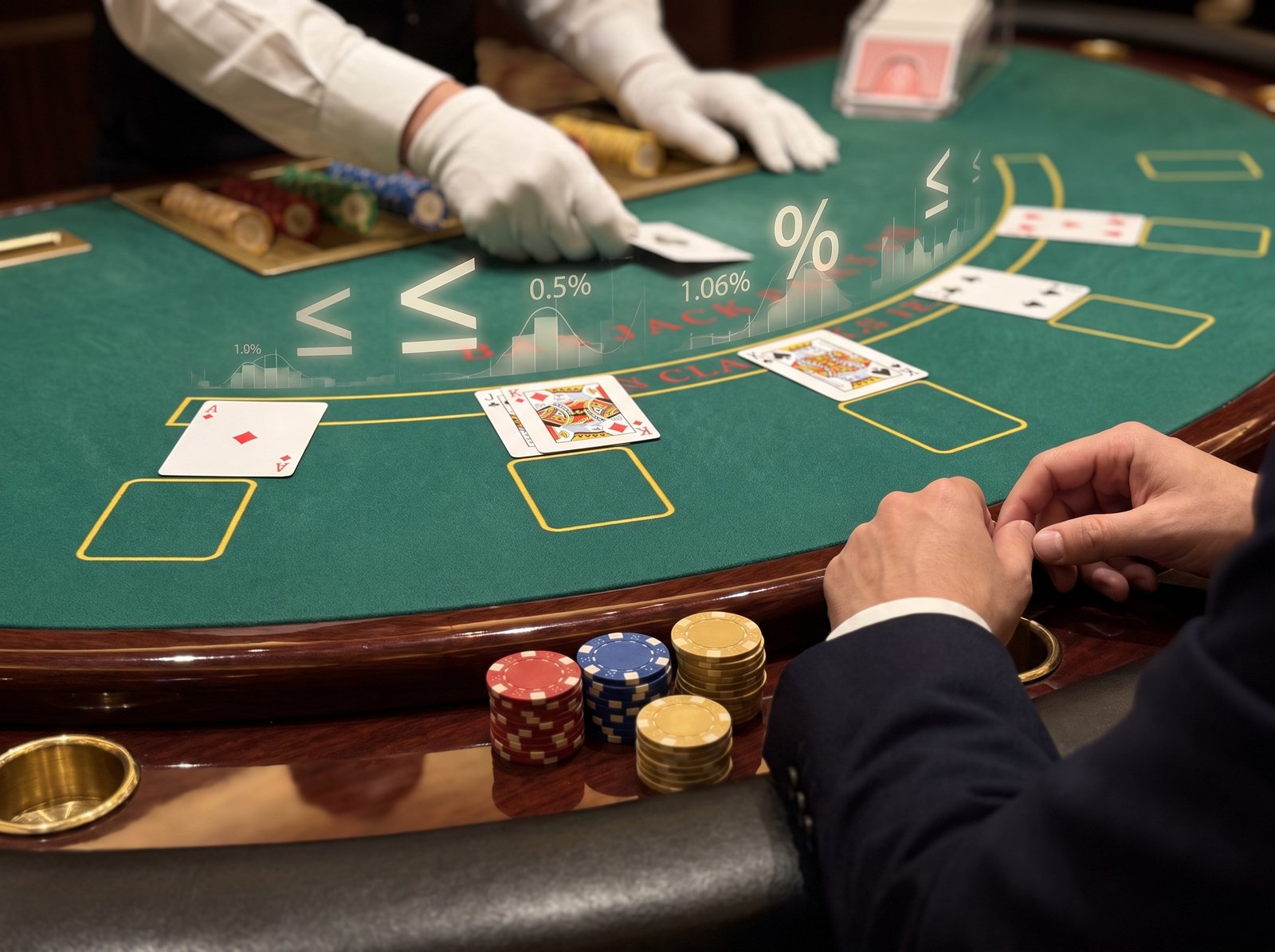
Blackjack is often described as one of the casino games where players can get very close to the house on mathematical terms. That reputation leads to an important question: why does the casino still have an advantage? Why does the house have an edge in blackjack when players can make decisions, choose when to hit or stand, and even use basic strategy to improve their results?
The answer is built into the rules and structure of the game. Blackjack is not designed so that the casino wins every hand. Instead, the house edge comes from a combination of outcomes that favor the casino over a very large number of hands. The dealer follows fixed rules, players act first, natural blackjack payouts may vary, pushes return the original wager, and several rules influence the expected value of common decisions.
Table of Contents
Understanding these details can make blackjack much easier to approach. Instead of thinking about the game as a mystery, you can see it as a probability system. In this guide, we will explore why does the house have an edge in blackjack, how the edge is calculated, which rules matter most, how basic strategy changes the picture, and what sensible players can do to reduce unnecessary losses.
Why Does the House Have an Edge in Blackjack? The Basic Explanation
At the heart of the issue is a simple fact: players must act before the dealer. That rule creates an important source of risk. If a player goes over 21, the hand loses immediately, even if the dealer would have busted on the next step. This gives the casino a structural advantage because the dealer only needs to complete the hand after the player has already survived the risk of busting.
This is one of the clearest reasons the house advantage in blackjack exists. The casino does not need to win every confrontation. It only needs the rules to produce slightly more favorable results for the house over time. When millions of hands are played, even a small mathematical advantage can become significant.
Players can reduce mistakes by following mathematically sound decisions, but they cannot normally remove the built-in advantage completely. The exact edge depends on the rules, number of decks, blackjack payout, dealer behavior on soft 17, doubling restrictions, splitting rules, surrender options, and other conditions.
That is why two blackjack tables can look almost identical while offering meaningfully different long-term odds.
How the House Edge Works Over Thousands of Hands
The phrase house edge does not mean that the casino expects to win every session. It refers to the casino’s theoretical long-term advantage. If a game has a house edge of 0.5%, for example, the mathematical expectation is that the casino will retain about $0.50 for every $100 wagered over a very large sample, assuming players follow the relevant assumptions.
Real sessions can look completely different. A player might win several thousand dollars in an hour, or lose a similar amount quickly. Short-term outcomes are heavily affected by variance. The house edge becomes more meaningful as the number of hands and total amount wagered increase.
This distinction matters because blackjack can produce surprisingly large swings. A table can have favorable rules and still produce a losing session. A table with a higher edge can produce a winning session. Neither outcome changes the underlying probability.
The key concept is expected value. A casino game can be unfavorable to the player while still allowing frequent short-term wins. Over time, however, the mathematical structure tends to pull results toward the expected range.
Why the Player Must Act First
One of the most important blackjack rules is that the player completes their hand before the dealer plays. Suppose your hand totals 16 and the dealer is showing a 10. You choose to hit and receive a 9, giving you 25. Your hand is now a bust, so you lose immediately.
The dealer never has to finish the hand.
If the dealer would have drawn cards and eventually reached 26, that does not matter because your hand was already dead. This creates a disadvantage that does not exist in exactly the same form for the dealer.
This rule explains the house advantage in blackjack even though the same deck is being used by both sides. The sequencing of decisions matters. The player carries the risk of busting before the dealer’s outcome is known.
Basic strategy is designed partly around this reality. It does not change the rule. Instead, it helps the player make the least harmful decision in each situation.
Natural Blackjack and the Importance of the Payout
A natural blackjack occurs when the first two cards are an ace and a ten-value card. Traditionally, many games pay 3:2 on a natural blackjack. That payout is one of the most important features affecting the house edge.
If a casino changes the blackjack payout from 3:2 to 6:5, the player’s long-term expectation becomes significantly worse. A natural blackjack is relatively uncommon, so the change may not look dramatic from hand to hand. Mathematically, however, the lower payout can add a substantial amount to the house advantage.
This is a major reason the house advantage in blackjack can have different answers at different tables. Rules matter.
A player who understands blackjack should check the payout before placing a wager. A beautiful casino floor, large digital display, or attractive bonus does not compensate for a poor base rule.
Dealer Rules Can Change the House Advantage
Another major factor is what the dealer does with a soft 17. A soft 17 is a hand such as ace-6, where the ace can be counted as either 1 or 11. Some blackjack games require the dealer to stand on soft 17, while others require the dealer to hit.
When the dealer hits soft 17, the house generally receives a small mathematical benefit because the dealer gets an extra opportunity to improve the hand. That change may sound minor, but tiny rule differences matter over thousands of hands.
This is another answer to the house advantage in blackjack: the casino controls the rules governing dealer behavior, and those rules influence probability.
Players should always review the table rules rather than assuming all blackjack games are identical.
The Number of Decks Also Matters
Blackjack can be dealt from a single deck or several decks. Multi-deck games are common in casinos because they make card management easier and can support continuous or automatic shuffling systems.
The number of decks affects probabilities because the composition of the remaining cards changes differently depending on how many cards are already out of play. In some rule sets, a single-deck game can offer a lower house edge than a comparable multi-deck game.
However, deck count alone is not enough to judge a table. A one-deck game with a 6:5 blackjack payout may be worse than a multi-deck game paying 3:2 with better doubling and splitting rules.
The complete rule package matters more than any single feature.
Why Basic Strategy Helps but Does Not Eliminate the Edge
Basic strategy is a mathematically derived decision system that tells a player when to hit, stand, double, split, or surrender based on the player’s hand and the dealer’s visible card.
Using basic strategy can dramatically reduce the amount of money a player loses to poor decisions. It helps prevent common errors, such as standing when hitting has a higher expected value or splitting pairs when it is mathematically weaker.
But basic strategy does not turn a normal casino blackjack game into a guaranteed winning system.
This is an important answer to the house advantage in blackjack. Strategy can optimize the player’s decisions under the existing rules, but it cannot rewrite those rules.
In favorable games, perfect basic strategy can bring the house edge down to a very small percentage. In unfavorable games, it cannot fully overcome costly rules such as poor blackjack payouts.
Common Player Mistakes Increase the Real-World Loss
The published house edge usually assumes correct or near-correct play. Many players do not play perfectly. They may make decisions based on emotion, superstition, recent results, or other players’ actions.
For example, a player may refuse to hit a low hand because they are afraid of busting, even when hitting is statistically correct. Another player may increase bets aggressively after a loss because they believe a win is “due.”
These behaviors can make actual losses much larger than the theoretical edge of the game.
The biggest practical lesson is that blackjack is not only a math problem. It is also a decision-making and bankroll problem.
Why Does the House Have an Edge in Blackjack When Players Can Win?
This question often causes confusion. If the house has an edge, why do players win so often?
Because a positive house edge does not mean a guaranteed house win on every hand. Blackjack contains many outcomes. A player can win a hand, lose a hand, or push. Natural blackjacks can create larger payouts. Doubles and splits can also change the size of individual results.
Variance causes short-term outcomes to move dramatically above or below expectation.
Imagine flipping a fair coin where one side pays slightly less than the other. You can still get ten wins in a row. The fact that one side has a statistical advantage does not determine every short-term result.
The same concept applies to blackjack. The casino’s advantage becomes visible over a much larger number of trials.
What Is the Typical House Edge in Blackjack?
There is no single house-edge number that applies to every blackjack game.
With favorable rules and perfect basic strategy, the house edge can be very low, sometimes around a fraction of a percent. With poor rules, it can rise considerably. The exact result depends on the deck count, payout structure, dealer rules, double restrictions, split rules, surrender availability, and other table conditions.
Players should therefore treat any claim that “blackjack always has a 0.5% house edge” with caution. That number may describe one particular rule set, not every blackjack table.
When evaluating a game, look at the rules as a whole.
How Blackjack Payouts Affect Long-Term Results
Payouts determine how much a successful wager returns. Consider two tables that are identical except for blackjack payout.
On the first table, a natural blackjack pays 3:2. A $100 wager returns $150 in profit, plus the original $100 stake. On the second table, a blackjack pays 6:5, so the same $100 wager produces only $120 in profit.
That difference may appear modest on one hand. Over hundreds or thousands of blackjack naturals, the reduced payout can materially increase the casino’s advantage.
This is why experienced players often pay close attention to the exact wording printed on the table. A small change in a payout rule can have a much larger effect than a flashy promotional offer.
How Doubling Rules Influence the House Edge
Doubling down allows a player to increase the initial wager, usually after receiving the first two cards, and receive exactly one additional card.
Flexible doubling rules can be beneficial to players because they allow more situations where a strong mathematical opportunity can be exploited. Restrictions, such as allowing doubles only on certain totals, reduce that flexibility.
A table that permits doubling on any first two cards is usually more player-friendly than one with strict limits.
Once again, this helps explain the house advantage in blackjack from a rules perspective. The casino can shape the decision tree. The more restrictions placed on favorable player actions, the greater the potential house advantage.
How Splitting Rules Affect the Mathematics
When a player receives a pair, they may be allowed to split the cards into two separate hands by placing an additional wager equal to the original bet.
Splitting can be mathematically powerful in some situations, especially with certain pairs. It can also create extra exposure because the player is effectively creating more than one wager.
Rules about resplitting, splitting aces, and doubling after a split can have a noticeable impact on the overall house edge.
For example, a table that lets players resplit certain pairs may be more favorable than a table that strictly limits the number of splits.
The details matter because blackjack is a collection of small probability decisions rather than one single rule.
What Is the Role of Surrender?
Surrender gives the player the option to forfeit a portion of the original wager rather than continue with a weak hand. Not every blackjack game offers it.
When available under appropriate conditions, surrender can reduce losses because the player avoids paying the full wager when the situation is heavily unfavorable.
Early surrender and late surrender are different rule types, and their mathematical effects are not the same.
A player researching why does the house have an edge in blackjack should know that surrender is one of the rule variations that can shift the edge in the player’s favor.
Insurance Often Works Against the Player
Insurance is offered when the dealer’s upcard is an ace. The player can make an additional wager that the dealer has a blackjack.
The payout is often 2:1, but the probability of the dealer having a ten-value hole card is not high enough in ordinary blackjack to make insurance a favorable bet for a basic-strategy player.
For most players, insurance is not a good way to overcome the house edge. It is a separate side wager with its own mathematical expectation.
This is one reason it is useful to distinguish the main blackjack game from side bets. A table may advertise multiple side opportunities, but those bets often carry much higher house edges than the core blackjack wager.
Side Bets Can Increase the Overall Cost of Playing
Modern blackjack tables frequently include optional side bets based on card combinations. Some are linked to pairs, suited cards, dealer outcomes, or specific patterns.
These bets can be entertaining, but their house edges are often far higher than the base blackjack game.
A player may therefore use excellent basic strategy while still giving up a lot of expected value by repeatedly adding side bets.
If the goal is to minimize mathematical disadvantage, focusing on the main game and understanding the rules is usually more important than chasing bonus payouts.
How Bankroll Management Fits Into Blackjack Strategy
Mathematical knowledge does not protect a player from poor bankroll decisions.
A sensible bankroll approach starts with accepting that losing sessions are possible. No strategy can guarantee a profit in a game with a house edge. Players should decide in advance how much money they are willing to risk and avoid increasing wagers solely to recover previous losses.
Bet sizing should also match the bankroll. Large wagers create larger swings and can produce rapid losses even when the underlying game has a relatively low edge.
Good bankroll management cannot eliminate the house advantage, but it can help prevent a bad session from becoming a serious financial problem.
Can Card Counting Remove the House Edge?
Card counting is based on tracking the changing composition of the deck and adjusting bets or decisions when conditions become more favorable.
Under certain game conditions, skilled card counters can potentially gain a mathematical advantage over the casino. However, this is difficult to execute, requires discipline and accurate tracking, and is not the same as memorizing basic strategy.
Casinos may also use procedures designed to reduce the effectiveness of counting, including frequent shuffles and continuous shuffling machines.
This topic is often oversimplified online. Card counting is not a magic trick, and it does not guarantee profit. It also does not change the underlying explanation of why does the house have an edge in blackjack for ordinary players who are using standard strategy at a normal table.
Why Does the House Have an Edge in Blackjack Despite Player Skill?
Skill matters because blackjack is one of the few casino games where decision quality can significantly influence expected results.
However, skill operates within a rule set. A highly skilled player can make the best available choice while still facing an unfavorable expectation if the table rules are poor.
Think of it this way: basic strategy is about choosing the best road available. It does not rebuild the road network.
That is why the smartest blackjack approach is not simply “play perfectly.” It is “play correctly at the best available rules and manage your risk.”
A Simple Example of Expected Value
Suppose a hypothetical blackjack table has an average house edge of 0.5%, and you wager a total of $10,000 over a large enough sample.
A theoretical expectation would be about $50 in casino advantage.
That does not mean you will lose exactly $50. You might finish up by hundreds of dollars or down by thousands. Variance creates the difference.
The figure is useful because it explains the concept of long-term expectation. It is not a prediction of your next session.
This is another crucial point when thinking about why does the house have an edge in blackjack. Expected value describes a long-run average, not an individual outcome.
How to Find a More Player-Friendly Blackjack Table
Players who want better odds should read the rules before sitting down.
Look for the best available blackjack payout, reasonable dealer rules, flexible doubling and splitting conditions, and surrender when offered. Compare tables instead of assuming every game in the casino has the same edge.
Live online blackjack can also vary by game rules, so the same principle applies. Read the game information and terms before wagering.
The goal is not to search for a guaranteed winner. The goal is to avoid unnecessary disadvantages.
Why Chasing Losses Makes the House Edge Worse
Losing can create a powerful emotional reaction. A player may feel that the next hand has to be better or that a larger wager is necessary to get even.
But previous hands do not create an obligation for the next hand to win. Each hand has its own probabilities within the game’s rules.
Increasing the wager after losing can dramatically increase risk while leaving the underlying house edge unchanged.
If a table has a mathematical disadvantage, betting more money does not remove that disadvantage. It simply increases the amount exposed to it.
This is one of the most important practical lessons for anyone researching why does the house have an edge in blackjack.
Is Blackjack a Good Choice for Players Who Like Strategy?
Blackjack is appealing because player decisions matter more than in many purely chance-based casino games. A well-designed basic strategy can reduce unnecessary errors, and careful table selection can improve the mathematical position.
However, it is still a gambling game. There is no guaranteed income, and even low-edge play can involve large short-term losses.
The strategic appeal should therefore be understood as a way to make better decisions, not as proof that the player can always win.
Responsible Ways to Approach Blackjack
A responsible blackjack session starts before the first card is dealt. Decide what you can afford to lose, set a time and spending boundary, and treat the wager as entertainment rather than guaranteed income.
Avoid playing with money reserved for essentials. Do not borrow money to continue gambling, and do not chase losses by increasing stakes emotionally.
Taking breaks can also help keep decisions rational. A clear-headed player is less likely to make expensive mistakes.
Understanding why does the house have an edge in blackjack should reinforce this mindset. The casino has a built-in mathematical advantage, so responsible limits are especially important.
Final Takeaway: Understand the Rules Before You Play
The reason why does the house have an edge in blackjack comes down to the structure of the game. Players can bust before the dealer acts, blackjack payouts can favor the house, dealer rules affect probabilities, and restrictions on doubling, splitting, and surrender can increase the casino’s advantage.
Basic strategy helps players make better decisions and can reduce the house edge substantially, but it does not normally remove the casino’s built-in advantage.
The smartest approach is to understand the rules, compare tables, avoid costly side bets, manage your bankroll, and never confuse short-term winning streaks with a guaranteed long-term advantage.
The clearest way to understand why does the house have an edge in blackjack is to separate short-term results from long-term expected value.
When comparing tables, knowing why does the house have an edge in blackjack can help you notice unfavorable rules before you place a wager.
Understanding why does the house have an edge in blackjack also explains why a lower house edge is not the same thing as a guaranteed win.
Players often search for why does the house have an edge in blackjack after seeing how many decisions they can make during a hand.
The better you understand why does the house have an edge in blackjack, the easier it becomes to judge whether a table’s rules are attractive or costly.
It is useful to revisit why does the house have an edge in blackjack whenever a casino advertisement makes a game sound almost unbeatable for the house.
Learning why does the house have an edge in blackjack can also help new players distinguish sensible strategy from myths about luck, streaks, and momentum.
Ultimately, asking why does the house have an edge in blackjack is really an invitation to learn how probability, payouts, and player decisions work together.
If you are interested in blackjack, use this knowledge before your next session. Check the blackjack payout, review the dealer rules, understand the available player options, and decide on a firm budget before you play. A few minutes of preparation can help you avoid unnecessary disadvantages and make more informed decisions.
Frequently Asked Questions
Why Does the House Have an Edge in Blackjack Even When I Use Basic Strategy?
Basic strategy minimizes player errors and gives the best mathematical decision for common situations, but it works within the rules of the game. The casino can still retain a small edge because players act first and because the table’s payout and rule structure favor the house.
Does a 3:2 Blackjack Payout Really Matter?
Yes. The 3:2 payout is generally much more favorable to the player than a 6:5 payout. Because natural blackjacks occur regularly over many hands, changing the payout can have a meaningful impact on the long-term house edge.
Can I Guarantee a Profit by Counting Cards?
No. Card counting can change the mathematical expectation under certain conditions, but it is difficult, error-prone, and subject to casino countermeasures. It should never be viewed as a guaranteed profit system.
Are Blackjack Side Bets Worth Playing?
Most side bets carry a higher house edge than the main blackjack game. Some players enjoy them for entertainment, but they can significantly increase the cost of playing over time.
What Is the Best Way to Reduce the House Edge?
Learn basic strategy, choose player-friendly table rules, favor better blackjack payouts, avoid unnecessary side bets, and manage your bankroll carefully. These steps can reduce avoidable disadvantages even though they cannot guarantee profit.