
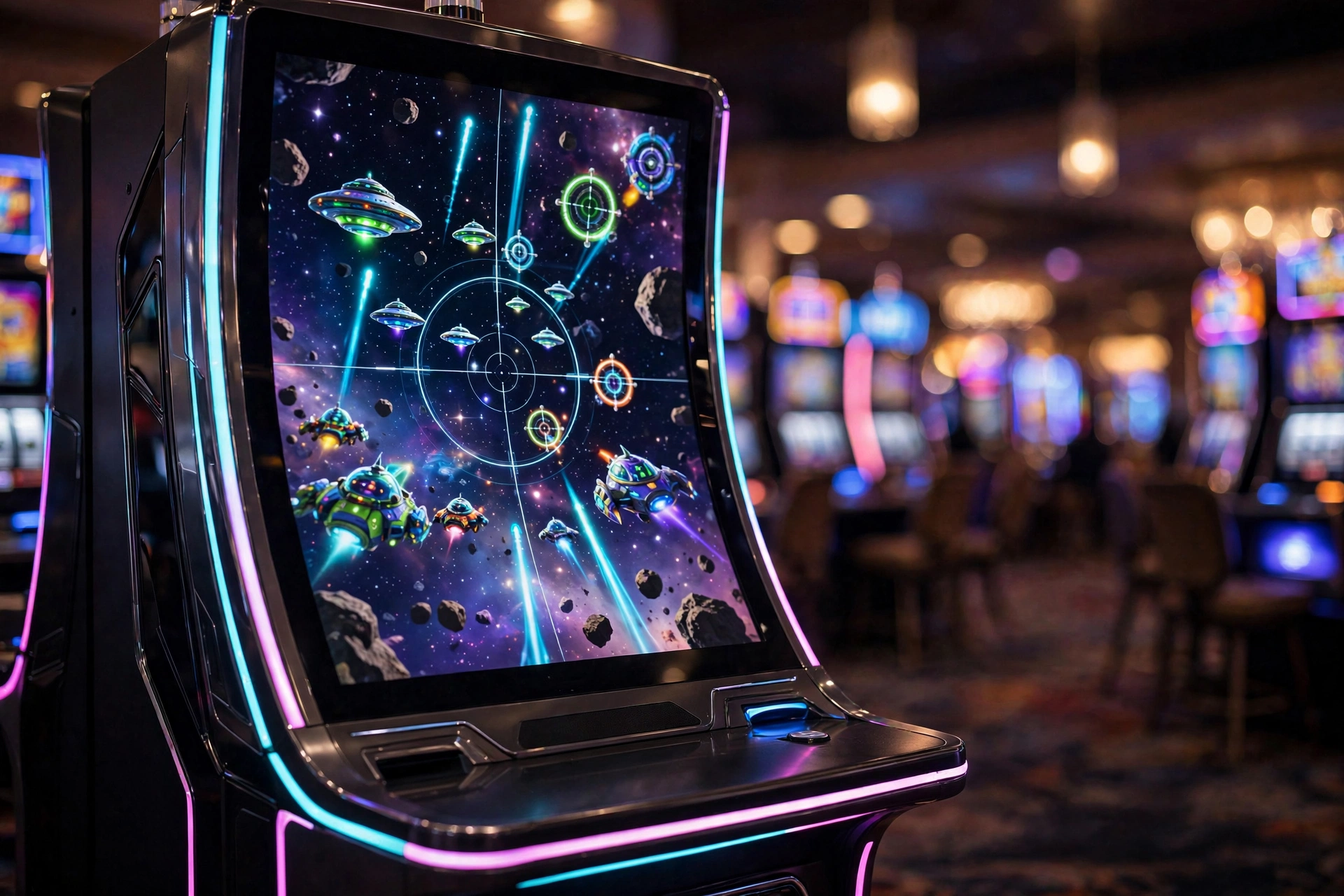
I will be honest with you: the first time I walked past a skill-based slot machine on a casino floor, I thought someone had smuggled an arcade cabinet into the building by mistake. There were aliens on the screen, a little joystick thing built into the cabinet, and a guy who looked about twenty-five years old happily blasting space invaders while his credits ticked up and down. That was my introduction to the concept, and what is a skill-based slot machine became a question I kept asking myself for weeks afterward.
Here is the short answer before we go deep: a skill-based slot machine is a casino game that looks and starts like a normal slot, but at least one part of it lets your actual ability — your aim, your reaction time, your puzzle-solving — influence how much you win. It is not a video game where skill decides everything, and it is not a normal slot where you just press a button and pray. It sits somewhere in between.
That in-between part is exactly why these machines are so interesting, and exactly why there is so much confusion about them. In this guide I am going to walk you through everything the way a friend would: how they actually work, where your skill really matters, where it does not, what the casinos allow and what the regulators said, and whether a good gamer can genuinely do better on one of these than a casual player.
Table of Contents
What Is a Skill-Based Slot Machine? The Simple Definition
Let me give you the clean definition first, because everything else builds on it. A skill-based slot machine is a gambling device where the outcome of at least one portion of the game is influenced by the player’s skill, rather than being decided entirely by a random number generator. The skill can come from a bonus round, a mini-game, or some interactive challenge that interrupts the normal spinning-reel format.
The key phrase there is “at least one portion.” That matters a lot. When I first learned what is a skill-based slot machine, I wrongly assumed the whole game was like playing Call of Duty with money on the line. It is not. Most of the game is still a slot machine. You still have spinning reels, you still have paylines, and a big chunk of your results are still pure chance. The skill element lives inside a specific moment of the game — usually a bonus feature — where what you do with your hands actually moves the payout needle.
Think of it like this. A normal slot is a lottery ticket with pretty graphics. A skill-based slot machine is a lottery ticket where, if you win the draw, you get to walk up to a basketball hoop and your free-throw percentage decides how big the prize gets. The random part decides whether you get the opportunity. Your skill decides how much of that opportunity you convert.
How Skill Slots Differ From Traditional RNG Slots
To understand what makes a skill-based slot machine different, you have to know what it is different from. A traditional slot machine runs on something called a random number generator, or RNG. Every time you hit spin, the RNG spits out a random number that decides which symbols land where. Your timing means nothing. How hard you press the button means nothing. Your beliefs, rituals, and lucky hats mean nothing. The math is fixed, the odds are fixed, and the house edge is fixed.
On a skill-based slot machine, the RNG is still there and still doing most of the work. But the game also contains at least one moment where the machine hands you the controls. In that moment, the RNG steps back and you step forward. Shoot the targets more accurately and the payout is bigger. Solve the puzzle faster and the prize multiplier climbs. Miss everything and you still usually get a guaranteed minimum, because regulators would not allow a game where the player could realistically win zero after paying for a spin.
I find this distinction really important because it kills the biggest misconception right away. Nobody is asking you to be good enough to beat the casino through skill alone. The skill portion is capped, contained, and wrapped inside a chance-based game. The difference is real, but it is bounded — more on that when we talk about RTP, because that is where this gets genuinely interesting.
How a Typical Skill Bonus Round Works, Step by Step
Let me walk you through a typical session on a skill-based slot machine, because seeing the sequence makes everything click.
Step one is the base game. You sit down, put in your credits, and spin. This part is identical to a normal slot. Reels spin, symbols land, small line wins come and go. Your skill does absolutely nothing here. The RNG is fully in charge, exactly like how online slots work on your phone — the spin result is locked in before you even see the animation.
Step two is the trigger. Somewhere in the base game there is a combination — usually scatter symbols or a special bonus symbol — that launches the skill portion. This trigger itself is random. You cannot force it with skill. It just happens on some spins, the same way a free-spins bonus triggers on a normal slot.
Step three is where it gets fun. The machine shifts into a mini-game, and this is the skill portion. The screen changes completely. Now you might be aiming and shooting at moving targets, steering a little race car through checkpoints, matching puzzle pieces against a timer, or answering quick-fire trivia. Your performance here is measured: how many targets you hit, how fast you finished, how accurate you were.
Step four is the payout calculation. The game converts your performance into a payout, but always within a pre-set range. A perfect run might earn you the maximum bonus award. A terrible run might earn you the minimum — and the minimum is still a real payout, never zero. In between, your score maps onto a scale of possible awards. So your skill moves you along that scale, but the scale itself was designed by the game maker, and the house edge is baked into it.
This structure is the whole secret of the format. The random parts decide how often you reach the skill part, and the skill part decides where you land within a controlled range. Both pieces matter, and neither piece lets you take over the game.
Real Examples of Skill-Based Slot Titles
I want to talk about real machines here, because abstract descriptions make this sound weirder than it is. Let me describe the kinds of titles that have actually appeared on casino floors, purely so you can picture them — this is not a recommendation to go play them.
The first wave came from companies like GameCo, which built arcade-style cabinets that looked more like something from a mall arcade than a casino. Their flagship games had players shooting at alien invaders and knocking down objects for prizes. The company aimed squarely at younger players who grew up on video games and found traditional slots boring. The pitch was simple: the casino floor had a video game now, and it paid real money.
Another company, Gamblit, took a different approach. Instead of building traditional cabinet games, they made table-style games where players could bet on competitive video-game-style contests, and they also built skill-influenced slot concepts. Their tables let you play against other players in game-like challenges with real money on the line, which was closer to a poker-table experience than a slot experience.
Then there were the arcade-style titles from established manufacturers. Next Gaming, for example, created games where the player interacts directly with the screen — shooting gallery-style gameplay layered on top of slot mechanics. One concept had players blasting objects on screen, where hits converted into credits. The idea was to wrap familiar slot payouts in the physical feeling of an arcade game.
What all of these had in common was the format I described above: a chance-based framework with a skill-based moment inside it. None of them let a skilled player turn the game into an ATM. They just let you feel like your hands mattered for once, which, for a generation raised on controllers, was a big deal.
The History: The 2016-2019 Hype and Why It Fizzled
Now let me tell you the story of what actually happened to these machines, because it is a fascinating little piece of casino history and it explains why you might not have seen one lately.
The hype began around 2016. The industry had a problem it could see coming a mile away: traditional slot players were aging. The average slot player was getting older every year, and younger visitors — millennials who grew up on PlayStation and Xbox — were walking straight past the slot floor to the table games or, more often, just not gambling at all. The casino industry looked at that trend and panicked a little. Their biggest revenue source was aging out, and the replacement generation did not care about spinning reels.
Skill-based slots were supposed to be the answer. The theory was clean and persuasive: young people like video games, so give them casino games that feel like video games. Manufacturers rushed to build them. Regulators moved surprisingly fast — Nevada passed Senate Bill 9 in 2015, which allowed game outcomes to be affected by player skill, and the Nevada Gaming Commission approved regulations for skill-based and hybrid games. New Jersey followed. The stage was set.
The machines hit floors around 2016 and 2017 to enormous press coverage. And then… not much happened. The early machines struggled for a few reasons I will be honest about. First, the skill elements were often shallow — shooting targets got old after ten minutes. Second, experienced gamers found the skill portions too easy to be satisfying, while casual players found them frustrating. Third, and most importantly, the math confused people. Players could not tell whether they were playing a game of skill or a game of chance, and when your money is involved, confusion is poison.
By 2019, several early manufacturers had pivoted or shut down, and skill-based slots had shrunk from “the future of the casino floor” to an interesting experiment that mostly lived in a handful of properties. The dream of a skill-based casino floor did not die completely — new concepts kept appearing, and regulators kept the door open — but the 2016 hype wave definitely crashed on the rocks.
Regulation: How Nevada and New Jersey Said Yes
Here is the part that surprised me most when I researched it. Getting skill into a slot machine was not just a design problem — it was a legal problem, because for decades the law said slot outcomes had to be entirely random.
Nevada solved it in 2015 with Senate Bill 9, which amended the Nevada Gaming Control Act to allow gaming device outcomes to be affected by player skill or other nondiscriminatory factors. Before that law, the outcome of any gaming device had to be entirely random and could not be influenced by anything external. SB9 directed the Nevada Gaming Commission to adopt regulations covering three categories: games of skill (where skill predominates), games of chance (where chance predominates), and hybrid games (a mix of both). Most skill-based slot machines fall into that hybrid category.
The regulations also had to answer new questions nobody had asked before. What disclosures does the player get about how their skill affects the outcome? How do you prevent the game from being unfair to unskilled players? Can payout percentages vary based on the player’s ability? Nevada’s answer was: yes, variable payouts are allowed, but the game must clearly disclose what affects the outcome, and there must be fairness guardrails so an unskilled player is not being fleeced blind.
New Jersey took a similar path, updating its regulations to allow skill-based gaming devices. Other states watched and followed at their own pace. The point is that these machines are not some unregulated gray area. They exist because specific laws were written to allow them, with specific protections around them.
RTP and House Edge on Skill Slots: Who Wins What
This is the section where I want you to lean in, because the math behind what is a skill-based slot machine is genuinely different from a normal slot, and it is the part most articles gloss over.
On a traditional slot, the RTP — return to player — is a single fixed number. A 96% RTP slot returns 96 cents of every dollar wagered over the long run, and that number does not move no matter who is sitting at the machine. The house edge is locked in.
On a skill-based slot machine, the RTP is not one number — it is a range. Regulators allow the game to have a minimum RTP for a completely unskilled player and a maximum RTP for a perfect player. So a game might be designed so that someone who fumbles every bonus round gets back, say, 84% of wagers, while someone who plays the skill portions flawlessly gets back 96%. The exact numbers are set by the manufacturer and approved by the regulator, and they must be disclosed.
Notice what this means: even the perfect player does not get past 100%. The top of the range still leaves room for the house edge. Nobody, no matter how skilled, turns the game into a winning proposition over the long run. What skill does is move you from the bad end of the range toward the good end — it shrinks the house edge you personally face, but it never erases it.
That is also why regulators required the guaranteed minimum payout on skill portions. Without it, a genuinely terrible player could theoretically lose everything, which would be a consumer-protection nightmare. The floor protects the worst player; the ceiling protects the casino. Everyone in between just plays for where they land.
Who Skill-Based Slots Are Actually Good For
Let me be blunt about who these games are actually for, because the marketing made it sound like they were for everyone, and they are not. If you have read this far, you already understand what is a skill-based slot machine better than most people on the casino floor, so let me put that knowledge to work.
They are great for you if you find traditional slots mind-numbingly boring. If you have ever sat at a slot machine for ten minutes and felt your brain leaking out of your ears, the interactive bonus round on a skill-based slot machine is a genuine relief. It gives you something to do, something to react to, and a feeling that your hands matter. For entertainment value per dollar, a decent skill slot can beat a plain reel-spinner for a player like that.
They are also decent for you if you are a moderately competitive person who likes the feeling of improving at something. There is a real pleasure in noticing your bonus-round scores creeping up over a session. It is the same satisfaction as getting better at a mobile game, except the mobile game does not pay you.
They are not for you if you are looking for a game you can beat. Let me say that again clearly: no skill-based slot machine lets a good player beat the house over time. The ceiling is below 100% RTP by design. If someone tells you they have a strategy to profit on these machines, they are either confused or selling something.
And they are probably not for you if you just want to relax. The skill portions demand attention and reaction speed. Sometimes you want to sip your drink and watch cherries line up, and there is no shame in that.
Myths About Skill-Based Slots (And the Truth)
Let us clear out the myths, because this topic grows them like weeds. Most people who first ask what is a skill-based slot machine are really asking one hidden question underneath: can a good player beat the casino on these?
Myth one: “A pro gamer could beat the casino on these.” No. As I explained in the RTP section, the maximum payout range is capped below 100% return. A professional esports player and a seventy-year-old grandmother who has never held a controller will both lose money over time — the gamer just loses it more slowly. Skill moves you up the scale; it does not flip the scale.
Myth two: “The skill part is fake and the machine decides everything.” Also no, at least not on properly regulated machines. The skill portion genuinely measures your performance, and better performance genuinely maps to higher awards within the disclosed range. Regulators test these games. Could an unregulated knockoff fake it? Sure, but licensed machines in Nevada and New Jersey are held to the technical standards, and the whole point of SB9 was to make skill real and measurable.
Myth three: “These are just video games with a gambling skin.” There is a grain of truth here — the arcade feel is deliberate — but the chance-based framework underneath is a real gambling device with a real house edge. Treating it like a harmless video game is exactly the wrong attitude, especially for younger players the industry was targeting. The credits are real money, and the math favors the house.
Myth four: “They failed because casinos rigged them.” The early wave struggled for much more boring reasons: shallow gameplay, confused players, and the awkward truth that gamers who love skill hate losing to chance, while gamblers who love chance hate being asked to perform. It was a design and audience problem, not a conspiracy.
Tips for Trying a Skill-Based Slot Machine
If you are curious enough to try one — and honestly, curiosity is a fine reason — here is how I would do it, based on everything I have learned.
First, read the help screen before you put money in. Seriously. Licensed machines must disclose how skill affects the outcome, and that screen tells you what the skill portion actually is, what the payout range looks like, and what the minimum guaranteed award is. Two minutes of reading will make the whole session less confusing.
Second, set your budget before you sit down, and make it small. Treat it like paying for an arcade session plus a lottery ticket. These games are entertainment with a cost, not an investment. Decide what the evening is worth to you, and when that amount is gone, you are done.
Third, play the skill portion for real, but do not stress about being perfect. The difference between a mediocre bonus round and a great one is real money, but it is small money — a few extra dollars on a typical session, not a life-changing swing. Play with focus because it is more fun that way, not because you are grinding an edge.
Fourth, watch your time. Skill games are more engaging than traditional slots, and engagement is the enemy of the clock. It is easy to look up and realize an hour has vanished. Set a phone timer if you need to. The casino is happy to let you forget what time it is; you do not have to cooperate.
Fifth, and this is the big one: never chase losses by “playing better.” Your skill does not change the random parts of the game, and the random parts decide most of your results. If the base game is eating your credits, no amount of bonus-round heroics will dig you out. Walk away.
Are skill-based slot machines legal?
Yes, in jurisdictions that have specifically authorized them. Nevada led the way with Senate Bill 9 in 2015, which allowed gaming device outcomes to be affected by player skill, and New Jersey created similar rules. They are regulated gambling devices, not unregulated arcade games, and they must meet technical standards and disclosure requirements. For more on how new skill-based titles enter regulated markets, see this report from Gambling News.
Can you actually win more on a skill-based slot machine if you are good at games?
You can win more than a bad player on the same machine, but you cannot win more than the game’s designed maximum. Your skill moves your results up within a pre-set payout range, but the top of that range still keeps a house edge. Being good helps by losing less, not by winning overall.
What happens if you are terrible at the skill bonus round?
You still get paid. Regulators require a guaranteed minimum award for the skill portion, so even the worst possible performance earns you something. That minimum is usually modest, but it is never zero.
Are skill-based slot machines available online?
Mostly no, at least not in the same cabinet form. The skill-based slot concept was designed for physical casino floors with arcade-style cabinets. Online, the closest relatives are tournament formats and games with interactive bonus rounds, but the regulatory framework is different.
Why did the first skill-based slots fail to take off?
A mix of shallow gameplay, audience mismatch, and confusion. The skill portions were often too simple to satisfy real gamers and too demanding for casual slot players, and players could not easily tell how much their skill mattered. Several early manufacturers pivoted or closed, though the concept never fully died.
Conclusion
So, what is a skill-based slot machine, after all of that? It is a hybrid: a slot machine at heart, with a moment of genuine gameplay bolted on. The spin is still chance. The trigger is still chance. But the bonus round is yours — your aim, your reflexes, your decisions — and it genuinely moves your payout up or down within a range the regulators approved.
I think the fairest way to see these machines is as an experiment that was half right. The industry correctly sensed that younger players wanted more interaction, and it correctly built games that delivered it. Where it went wrong was in the fantasy that skill could replace chance as the core thrill. Most gamblers, it turns out, either want pure chance or pure skill — the hybrid satisfies each camp only halfway.
Should you try one? If you see one on a casino floor and you are curious, sure — with a small budget, a read of the help screen, and zero illusions about beating the house. Play the bonus round like you mean it, enjoy the arcade flashback, and walk away when your budget says so. So the next time someone asks you what is a skill-based slot machine, you can give them the short version: a slot that lets you play, but never lets you win.
Gamble responsibly. 18+ only.