
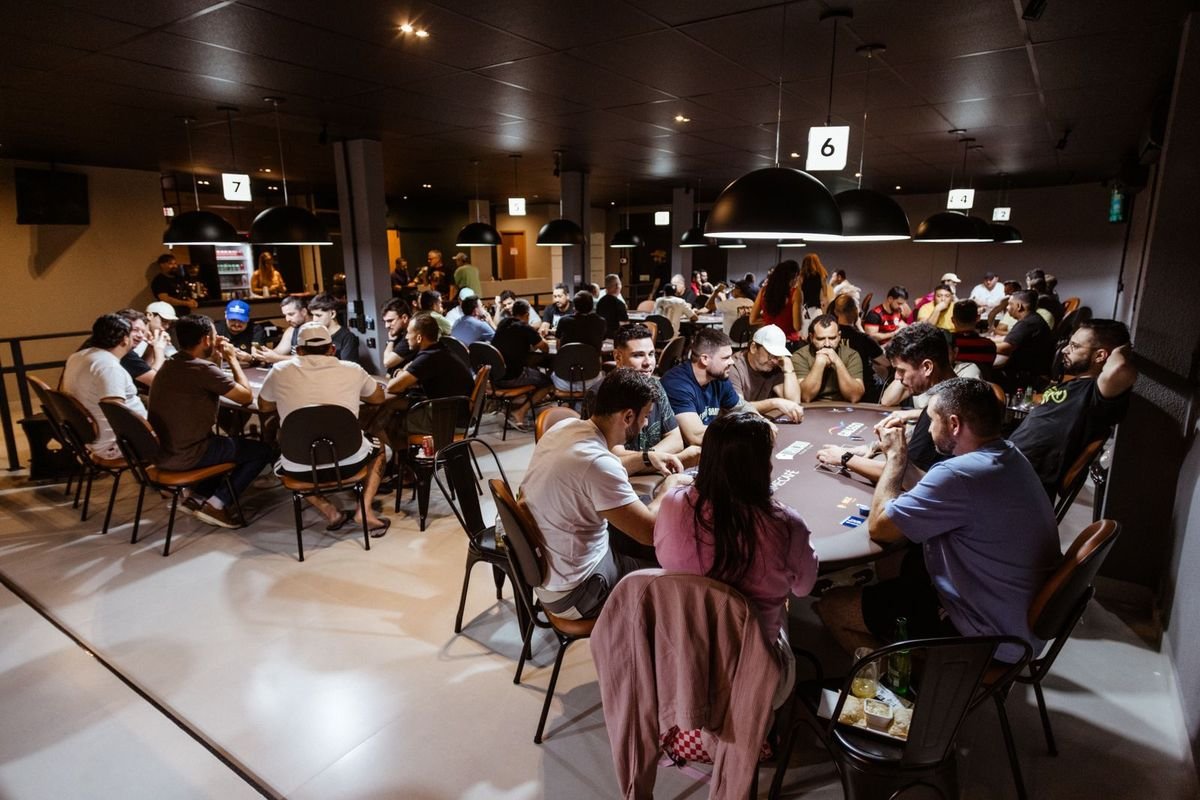
How do poker tournaments work? I asked myself that exact question the first time a friend invited me to a $20 buy-in event at his place, and I nodded along like I understood while secretly having no idea what a blind level even was. I showed up, bought in, got my stack of chips, and spent the first hour just trying to figure out why everyone kept folding when the blinds went up. By the end of the night I was hooked — and I wished someone had explained the whole thing to me in plain English before I sat down.
That’s what this guide is. No jargon walls, no maths degree required. Just a straight walkthrough of how a poker tournament actually runs, from the moment you pay your buy-in to the moment someone lifts the trophy (or, more often, two tired players agree to split the money and go home).
Table of Contents
What Is a Poker Tournament, Really?
A poker tournament is a competition where every player pays the same entry fee, gets the same number of chips, and plays until one person holds all the chips. That’s the whole idea in one sentence. You can’t cash your chips in halfway through like you can in a cash game — your chips only have value inside the tournament, and the only way to turn them into real money is to finish in the paying places.
The biggest difference between a tournament and a cash game is that the blinds keep rising. In a cash game, the blinds stay the same all night, and you can leave whenever you like. In a tournament, the forced bets go up on a schedule, which means the pressure builds every level. If you sit still and fold everything, the blinds will eventually eat your stack alive. That rising pressure is what makes tournaments so dramatic — and so much fun.
Another key difference is that you’re playing to survive, not just to win individual pots. In a cash game, every chip is worth real money, so you can make decisions based purely on expected value. In a tournament, losing all your chips means you’re out of the event entirely, so sometimes the right play is to fold a decent hand and live to fight another level. That survival instinct changes everything about how the game feels. How do poker tournaments work in practice, though? The rising blinds are the part that trips most beginners up, so let’s get into those.
The Buy-In and Your Starting Stack
When you enter a tournament, you pay a buy-in. That buy-in is usually split into two parts: the money that goes into the prize pool, and a smaller fee that goes to the house or the organiser. A “$50 + $5” tournament, for example, puts $50 of your money into the prize pool and charges you $5 as the fee. Online, you’ll see this written as “$55” with the fee baked in, but live events usually spell it out.
In return for your buy-in, you get a starting stack of tournament chips. A common setup is 10,000 or 25,000 chips, but the number itself doesn’t matter much — what matters is how many big blinds that stack represents. Starting with 10,000 chips when the blinds are 50/100 means you have 100 big blinds, which is a deep, comfortable stack. The same 10,000 chips at 500/1,000 blinds means you only have 10 big blinds, and you’re in push-or-fold territory.
This is the first thing I check before I register for any event: the starting stack relative to the blinds, and how long each level lasts. A tournament with a deep starting stack and slow levels gives you room to play real poker. A turbo event with a short stack and five-minute levels is basically a lottery with cards — fun, but a very different game. How do poker tournaments work if the starting stacks are different sizes? They aren’t — everyone starts equal, which is the whole point.
How Blinds and Antes Rise
Blinds are the forced bets that keep the action moving. Two players post them every hand — the small blind and the big blind — and everyone else can choose to call, raise, or fold. In a tournament, the blind levels increase on a timer, usually every 10 to 20 minutes online and every 20 to 40 minutes live. A typical structure might start at 50/100, then go to 75/150, then 100/200, and so on.
Antes usually join the party after the first few levels. An ante is a small forced bet that every player at the table pays before each hand, and it goes straight into the pot. Antes make the pot bigger before anyone has even acted, which gives everyone more reason to fight for it. Some tournaments use a “big blind ante” instead, where only the player in the big blind posts an ante for the whole table — it speeds things up and it’s become the standard in most live events I’ve played.
Here’s why the rising blinds matter so much: your stack is measured in big blinds, and as the blinds climb, your stack shrinks in real terms even if you haven’t lost a single chip. A stack of 100 big blinds at the start might be 15 big blinds two hours later if you’ve just been treading water. That shrinking stack is the clock ticking on your tournament life, and it’s the reason you can’t just wait forever for pocket aces. How do poker tournaments work when the blinds get high and stacks get short? That’s when the game changes completely — patience stops paying and aggression starts.
The practical takeaway is simple. Early on, when stacks are deep, you can afford to be patient and play solid, straightforward poker. Later, when the blinds are high and stacks are shallow, you need to get aggressive — stealing blinds, shoving with decent hands, and taking calculated risks — because folding your way to the money rarely works when the blinds are eating you alive.
Freezeout vs Rebuy vs Re-Entry vs Bounty (PKO)
Not all tournaments work the same way, and the format changes the strategy a lot. The four main types you’ll run into are freezeouts, rebuys, re-entries, and bounty tournaments. How do poker tournaments work across all these formats? The core rules stay the same — only the second-chance rules change.
A freezeout is the classic format: one buy-in, one stack, and when you lose your chips you’re out. No second chances. Most big championship events, including the World Series of Poker Main Event, are freezeouts. I like freezeouts because every decision matters — there’s no safety net, so people tend to play more carefully, and the poker is usually better.
A rebuy tournament lets you buy back in if you bust during a set rebuy period, usually the first few levels. Some events even let you rebuy when your stack drops below a certain level, not just when you’re out. Rebuys make the prize pool bigger and the early play looser — people gamble more because they know they can buy another stack. Just be careful: it’s easy to spend three buy-ins in a rebuy event before the rebuy period even ends.
A re-entry tournament is similar but stricter. If you bust, you can buy a completely fresh entry and get a new seat, often at a different table. Unlike a rebuy, you can’t top up a short stack — you have to be fully out first. Many online tournaments are re-entry events, and they usually allow a limited number of re-entries.
Then there are bounty tournaments, and my personal favourite, the progressive knockout (PKO). In a bounty event, part of your buy-in becomes a bounty on your head — knock someone out and you collect their bounty as cash, right there and then. In a PKO, half of the bounty goes into your pocket and the other half gets added to the bounty on your own head, so bounties grow as the tournament goes on. PKOs change the maths completely: sometimes it’s correct to call with a weaker hand just to try to win a big bounty. They’re chaotic, fun, and a great format for beginners because every knockout feels like a mini win.
Sit-and-Go vs Multi-Table Tournaments
Tournaments come in two broad shapes: single-table events and multi-table events. How do poker tournaments work if you only have an hour to spare? Play a sit-and-go. Got a whole Sunday free? Fire up an MTT.
A sit-and-go (SNG) is a tournament that starts as soon as enough players register — usually 6 or 9 players at a single table. There’s no scheduled start time; the game begins when the last seat fills. SNGs are quick, typically lasting 30 to 60 minutes, and the payout is usually simple: the top two or three players get paid. They’re a brilliant way to learn tournament poker because you get to experience every stage — early, middle, bubble, and heads-up — in under an hour.
Multi-table tournaments (MTTs) are the big scheduled events with dozens, hundreds, or even thousands of players spread across many tables. They have a fixed start time, and as players bust out, tables are broken up and the survivors are moved to fill the remaining seats. MTTs can run for hours — the big Sunday online events often take six or more hours to finish — and the payouts are much more top-heavy, with the winner taking a big chunk of the prize pool.
If you’re just starting out, I’d suggest playing a few SNGs first. They teach you the rhythm of a tournament without the massive time commitment, and the lessons transfer directly. Once you’re comfortable, MTTs are where the big scores live — just make sure you’ve got the time set aside before you register.
How the Money Works: Payouts and the Prize Pool
So where does the money actually go? All the buy-ins (minus the house fee) are pooled together into the prize pool. If 200 players each pay $50 into the pool, the prize pool is $10,000. Simple as that. How do poker tournaments work when it comes to the money? It all starts with that prize pool — and only the top 10 to 15 percent of finishers get a share of it. Some events also have a guaranteed prize pool, which means the organiser promises a minimum amount even if fewer players show up — and if the guarantee isn’t met, the organiser covers the difference, which is called an overlay and is basically free money for the players.
Only a portion of the field gets paid — usually around 10 to 15 percent. In a 200-player tournament, roughly the top 25 to 30 players will cash. The payouts are structured on a sliding scale: the minimum cash might be around double your buy-in, while the winner takes somewhere between 20 and 30 percent of the whole pool. Finishing first pays dramatically more than finishing tenth, which is why tournament strategy is so aggressive near the end — the real money is at the top.
The payout structure is published before the tournament starts, and I always check it before I register. A flat structure that pays lots of places small amounts suits a cautious player. A top-heavy structure rewards the gamblers who go for the win. Neither is better — it just changes how you should play when you’re near the money.
The bubble is the most tense moment in any tournament. It’s the point where one more elimination means everyone left is in the money. If 30 players get paid and 31 remain, nobody wants to be the 31st. Play tightens up dramatically on the bubble, and big stacks love to bully the table because short stacks are desperate to survive. If you can steal blinds on the bubble without risking your tournament life, it’s one of the most profitable spots in poker.
ICM Explained in Plain English
ICM stands for Independent Chip Model, and it’s the concept that makes tournament poker genuinely different from cash game poker. Here’s the plain-English version: in a tournament, your chips are worth less the more of them you have.
Think of it this way. If there are 10 players left, each with an equal stack, and the prize pool pays out to the top three, each player’s stack is worth one-tenth of the total prize money on average. Now imagine one player wins a huge pot and doubles their stack. Their chance of winning the tournament goes up — but not by double, because they can still only win first place once. Meanwhile, the chips they won came from other players, and the value those players lost is greater than the value the winner gained. Chips have diminishing returns. How do poker tournaments work at the final table? That’s where ICM takes over, and survival starts being worth real money.
This matters most on the bubble and at the final table. It’s why you should sometimes fold a hand that would be a profitable call in a cash game — because losing the hand costs you your tournament life and all your equity, while winning it only adds a bit of value. The classic example: you’re on the bubble with a medium stack, and a big stack shoves all-in. Even if your hand is ahead of their range, calling and losing means you bust with nothing, while folding keeps you alive to cash. ICM says fold.
You don’t need to do the maths at the table — plenty of free tools and apps will run ICM calculations for you. What you need is the intuition: near the money and near the final table, survival has real monetary value, and the chips you already have are worth more than the chips you might win. Once that clicks, a lot of tournament decisions start making sense.
Late Registration, Breaks, and Rebalancing
How do poker tournaments work if you show up after the cards are in the air? Most tournaments don’t lock the doors when the cards go in the air. Late registration is usually open for the first few levels — sometimes for an hour or more — and players who register late get a full starting stack, even though the blinds have already gone up. This means their stack is worth fewer big blinds than the players who started on time. I generally prefer to register on time, but late registration can be a smart move in a re-entry event if you bust early and want a fresh stack.
Scheduled breaks are part of the structure too. Most tournaments pause for five minutes every hour or so, and longer events have a proper dinner break. Use the break to step away from the screen, stretch, eat something, and reset your head. I’ve seen so many players tilt away their stack right after a break because they came back still steaming from a bad beat — the break is there for a reason, so use it.
As players bust out, tables get unbalanced. When one table drops to six players while another still has nine, the tournament staff (or the software, online) will move players around to keep the tables even. This is called rebalancing, and it’s completely normal. Don’t be surprised if you get moved to a new table mid-tournament — take a minute to size up your new opponents before you get involved in a big pot.
One more thing worth knowing: when the tournament gets down to the final couple of tables, play slows down for hand-for-hand dealing. This happens near the bubble — each table waits for the others to finish a hand before the next one starts, so nobody can stall their way into the money. It’s a bit tedious, but it keeps things fair.
How a Tournament Ends: Final Table, Heads-Up, and Deals
When only nine or ten players remain (or six, for a six-max event), they combine into the final table. This is where the money jumps get big — every elimination bumps everyone else up a pay level. Final table play is tense, strategic, and very different from the early stages. Stacks are usually shallow relative to the blinds, the pressure is enormous, and ICM considerations dominate every decision.
How do poker tournaments work when only two players are left? The game becomes heads-up, and everything speeds up. Heads-up play is a different beast entirely. The button posts the small blind and acts first before the flop, then acts second after the flop. Hand values change completely — any ace, any pair, and most kings are strong heads-up hands. It’s fast, aggressive, and a lot of fun. If you’ve never played heads-up before, just remember: you can’t wait for premium hands, because the blinds will eat you in a few orbits.
One of the most common sights at the end of a tournament is a deal, also called a chop. When the remaining players agree, they can split the prize money between them instead of playing it out. Deals are usually based on chip counts and ICM, and they’re often negotiated when the stacks are close or when the money jump is huge. There’s no shame in taking a deal — in fact, some of the best players in the world are famous for making smart deals. Just make sure any deal is agreed clearly by everyone involved, and remember that in most live events, a small amount is usually left to play for so there’s still a winner.
Online vs Live Tournaments
The rules of how do poker tournaments work are the same online and live, but the experience is very different.
Online tournaments are faster, cheaper, and more convenient. You can play from your sofa, multi-table several events at once, and find a tournament starting every few minutes at almost any buy-in level. The software handles the dealing, the blinds, the clock, and the payouts, so you can focus purely on decisions. The downside is that you can’t see your opponents — no physical tells, no table talk — and the pace can be brutal if you’re playing several tables at once.
Live tournaments are slower and more social. You get to watch people, chat between hands, and pick up on physical tells that don’t exist online. The atmosphere of a big live event — the chips, the cards, the crowd around the final table — is something every poker player should experience at least once. The downside is the time: a live tournament can take twelve hours or more, the buy-ins are usually higher because of the venue costs, and you can only play one table at a time.
My advice: learn online first, where the buy-ins are small and the volume is high, then take what you’ve learned to a live event when you feel ready. The skills transfer — the live game just adds the human element on top.
Beginner Mistakes and a Simple Survival Strategy
I’ve made every mistake on this list, so consider it a shortcut. The most common beginner error is playing too many hands early. When the blinds are small and your stack is deep, there’s no need to get involved with marginal hands — be patient, play strong hands, and let the impatient players donate their chips to you.
The second mistake is the opposite: playing too tight late. Once the blinds are high and your stack drops below 15 big blinds, you can’t afford to wait for aces. You need to be shoving with a wide range of hands — any ace, any pair, decent kings and queens — because folding costs you more than gambling. Understanding Texas Holdem starting hands is the foundation here: know which hands are worth playing from each position, and your decisions get much easier.
The third mistake is ignoring position. Acting last is a huge advantage in poker, and it’s even bigger in tournaments. The same hand that’s a fold from early position can be a raise from the button. If you only remember one strategic rule from this whole article, make it this one: play tight from early position and loose from late position.
The fourth mistake is tilting after a bad beat. Someone will crack your aces with a miracle river card — it happens to everyone, and it will happen to you. The players who survive tournaments are the ones who shrug, take a breath, and keep playing their game. The ones who tilt away their stack in the next three hands are the ones who donate.
So here’s my simple survival strategy for your first tournament. Play tight and solid in the early levels, when the blinds are small and patience costs nothing. Open up in the middle stages, stealing blinds and antes when the opportunity is cheap. When your stack drops below 20 big blinds, switch to push-or-fold mode and stop making small raises you can’t follow through on. And always, always be aware of the bubble — when survival is worth real money, tighten up if you’re short and attack if you’re deep. That’s it. You don’t need to be a genius to cash in your first tournament; you just need to be patient, disciplined, and a little bit brave at the right moments.
If you want to go deeper on structures, blind levels, and how the big events are run, the tournament coverage on PokerNews is a great place to see how the pros handle exactly these spots in real events.
Conclusion
So, how do poker tournaments work? You pay a buy-in, get a stack of chips, and play through rising blind levels until one player has them all. The formats vary — freezeouts, rebuys, bounties, sit-and-gos, multi-table monsters — but the core idea never changes: survive, accumulate, and be the last one standing.
The beauty of tournament poker is that anyone can win on any given day. I’ve seen first-timers outlast seasoned regulars just by staying patient and picking their spots. You don’t need a huge bankroll or a maths degree — you need a basic understanding of the structure, a bit of discipline, and the willingness to learn from every event you play.
My advice is simple: start small, play a few low buy-in events or sit-and-gos, and focus on enjoying the experience rather than the result. The wins will come. And when you do make your first final table — and you will, sooner than you think — you’ll know exactly how you got there.
Frequently Asked Questions
How long does a poker tournament last?
It depends on the format. A single-table sit-and-go usually takes 30 to 60 minutes, while a large multi-table tournament can run for six to twelve hours or more. Turbo events with fast blind levels finish much quicker than slow-structured events with deep stacks.
How much money do you need to enter a poker tournament?
Online tournaments start from as little as $1, while live events at a casino typically start around $50 to $100. Bigger festivals and championship events can cost thousands. A good rule is to only play buy-ins that are a small fraction of your total poker bankroll, so one bad run doesn’t wipe you out.
What happens if you run out of chips in a tournament?
In a freezeout, you’re eliminated and your tournament is over. In a rebuy or re-entry event, you may be able to buy back in during the designated rebuy or late registration period. Once that period closes, running out of chips means you’re out for good.
Can you leave a poker tournament early?
You can, but you forfeit your stack and any chance of cashing — your chips are simply removed from play and you get nothing back. In a cash game you can leave whenever you like, but in a tournament your buy-in only turns into money if you finish in the paying places, so leaving early means giving up entirely.
Do you have to pay tax on poker tournament winnings?
That depends on where you live. In some countries, gambling winnings are tax-free for recreational players, while in others they are taxable income. The rules vary a lot, so it’s worth checking the specific tax rules in your own country — or asking a local tax professional — before you assume anything.
Gamble responsibly. 18+ only.